Dirck Möllmann
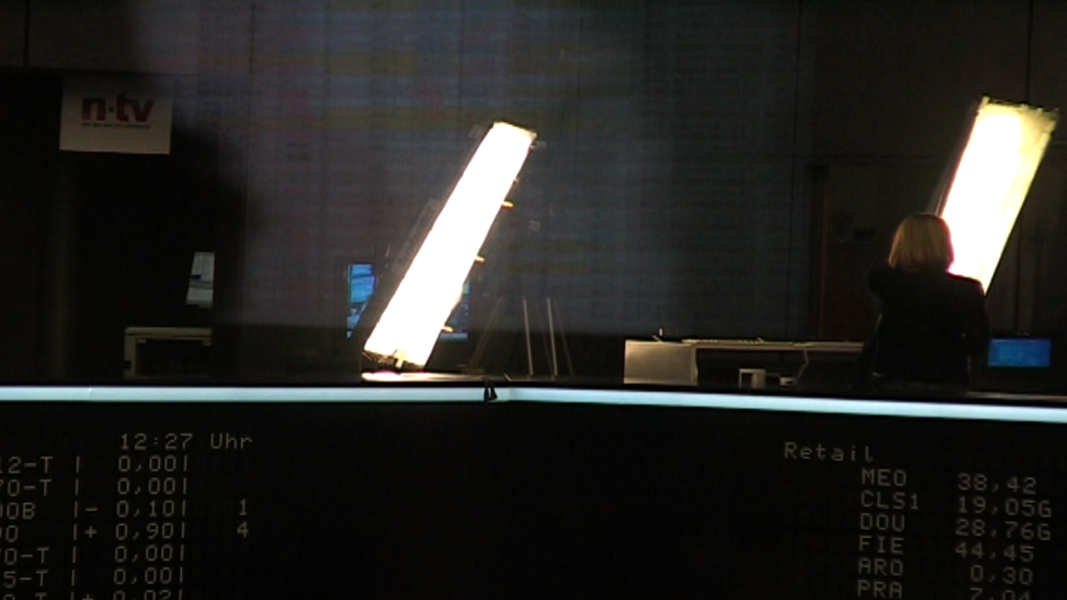
Mario Asef’s camera simply observes—it does not monitor (by recording everything in a blanket manner), it does not stare (by focusing unscrupulously), it does not gather (by picking up everything that passes before its lens), but it is just there, it observes what is happening, very directly, in the margins of goings-on and locations. It seems completely natural when a plastic bag catches its attention, following it as the wind buffets it about on a square in Buenos Aires (Edad de hielo / Ice Age, 2011). Or when it beholds a preacher for world peace at an intersection in London (Pass Over, 2003-5). Or it sits as a silent guest behind the visitor’s window at the Frankfurt Stock Exchange, registering the activities on the dreary floor in front of it and what is happening on the other side of the door outside (Börsianer / The Operators, 2009): the operators are working in the cut-throat field of global speculative trading as if in a semi-public cage, whereas those stranded on the streets are left to face its consequences with their own bodies. Images of artificial nature mediate between the agonal spheres.
The attentive gaze of Mario Asef’s camera quietly watches the everyday details of the world, thereby making it possible to draw conclusions about farther reaching injustices. Because of this his videos are not image apparatuses that produce big dramatic impressions, seduce through beauty, or seek to overwhelm the intellect. For Asef, video is first and foremost a simple technological possibility for splicing together observations of daily life, recording visual sketches, and later for tying these together artistically into complex layers of meaning. Inherent to the pensive observing of goings-on in public space is a claim to the public sphere. His videos not only address spaces and instances of authority or conquest, such as stock exchanges, revolutions, war, post-colonialism, or global trade, but they also undermine their appeal to power by showing the somewhat peripheral moments of everyday life and portraying the emptiness with signs of thoughtfulness and helplessness, with empathy, but also with humor and a sensibility for the small pleasures on the margins. In a certain sense, Asef’s particular narratives of daily experience perforate the ideal texture of a world conceived as a coherent actuality. Idea and reality are related together in a thought experiment that Asef, elsewhere, calls History Is Now.1 According to this motto, history would not be viewed as a resolved occurrence of the past, but seen as a process characterized by various temporal experiences that takes place in the here and now, without knowing what is next. It is the conception of a history that is continually transformed by stories. With Asef the historical occurrence becomes an open situation that evokes a “third text” between the signs.

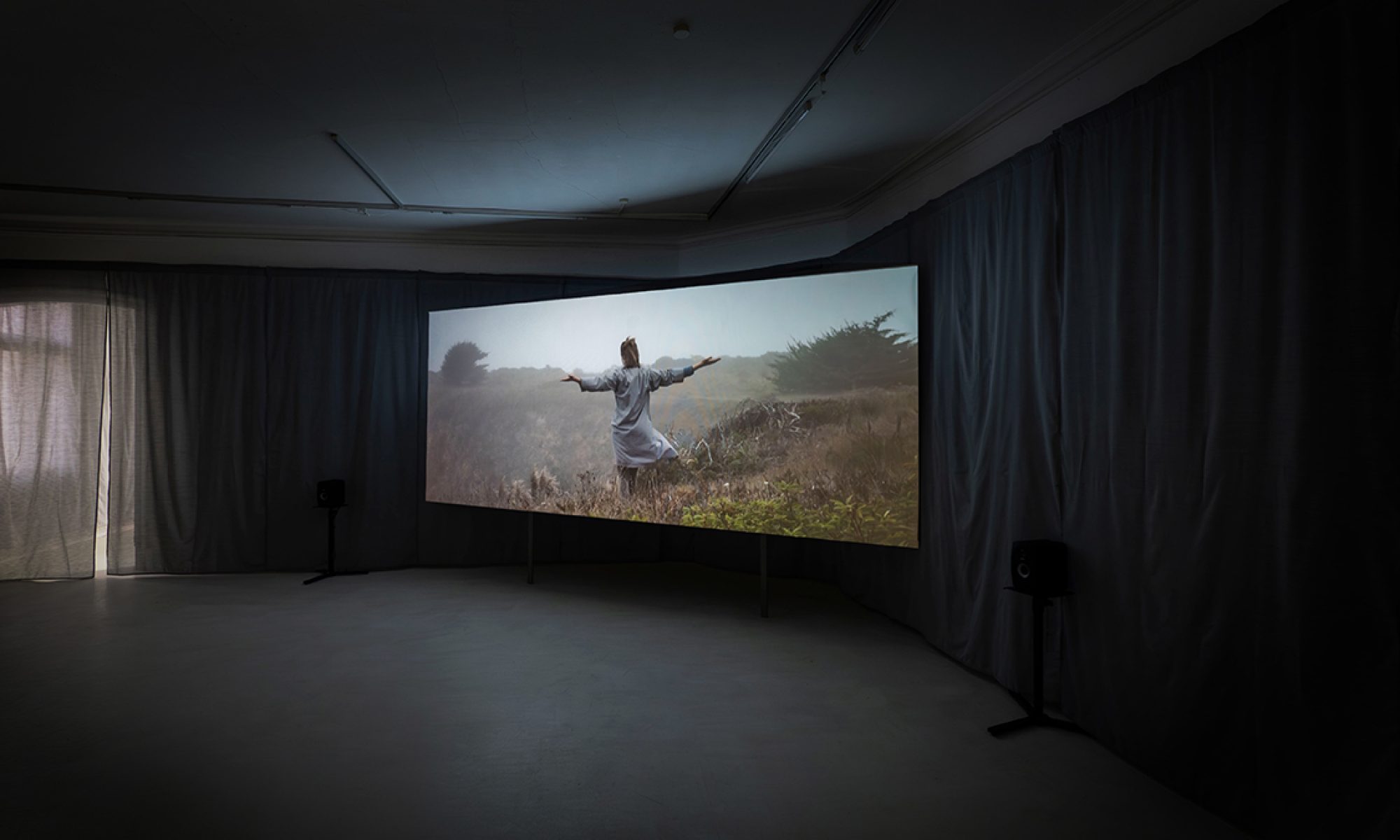
“Bolsa de comercio” means stock exchange in Spanish, but an ordinary plastic bag is also called a “bolsa.” With this commerce-bag double meaning in mind, Asef follows the movements of a plastic bag in a pedestrian zone in Buenos Aires in his video Edad de Hielo. Like a tumbleweed in the Wild West, the bag careens around the square. During the eight-minute long video the object comes to life for the viewer, becomes a lung that inhales and exhales, is stepped on, pauses, and with the next burst of wind becomes active again—what existential happenstance! What’s more, a voice-over in Spanish talks about nature as the only corrective factor in man’s striving for objectivity and ends with the rhetorical question: What remains after all the acquired knowledge and various prognostications other than concrete experience? Asef observes what’s happening with the camera in order to create a situation out of them in which the viewer is able to move or think more or less freely. Therefore it is necessary to leave the stories open-ended, to not tell them all the way, to not dot all the i’s and cross all the t’s, or provide them with an ending. Asef’s videos are based on detailed observations on a sculptural level. They do not provide an overview. They present modest materials in the streets of Buenos Aires or in post-revolutionary Bucharest (Revolution after Revolution, 2005), they portray desperate moments on the alleys of Frankfurt, or dogmatic monologues from jail. The scenes of underdogs, be it people or things, are spliced together with centers of power such as the stock exchange or the lunar conquest. In Man’s on Moon (2006), for example, one sees images of the moon landing, astronauts in spacesuits and their vehicles, while Charles Manson raps in staccato against society in his typical nagging voice. Both spheres, the extraterrestrial and the outcast, are in need of a survival capsule and thus Manson sees eye to eye with the man on the moon: “I am a mechanical man.” It is about the big questions, about the spirit that animates.

Bothered by the Border (2006-8) creates an entirely difference situation. The camera shows a man singing karaoke music live on a square in the middle of people. Mario Asef had been invited to South Korea. There he visits in a park a karaoke meeting point for war veteran retirees and spontaneously sings a song. The camera is located in the crowd and shows him at times as the singer and at times the dancers beside him. Asef heightens his exotic foreigner status by singing in overtone in a foreign language. He imitates a Tuvan song from Mongolia newly set to music by the folk rock band Yat-Kha. No one understands what Asef is singing and no one is bothered by this, on the contrary, everyone is quite amused. Even a few women join in among the large number of older men. Asef later recounts that they are prostitutes who visit the meeting place regularly and are paired with the elderly gentlemen by younger men behind the scenes. Nearly all the seniors were soldiers in the Korean War, which sealed the split between North and South Korea in 1953. It is their meeting point in Seoul and Asef seeks out this particular situation. After the fact, he dedicates the lyrics of his song Bothered by the Border on the split through Korean society to this generation of fighters. The subtitles, added later, construct for us viewers a narrative space in which anecdotes are combined with tragic history in a light-handed manner.
Asef is not so interested in sociological milieu-studies or the psychological intimacy of individuals, which are often tritely put forward especially in art these days. Instead, in his videos he compiles meta-stories on the formation of narratives and history itself. Sabeth Buchmann, in conversation with the artist, coined the designation “social Minimalism”2 for his three-dimensional work, insofar as traits of historical Minimalism of the 1960s to the 90s (so-called object-based art, concept art, institutional critique, contextual art) are recognizable but are underpinned with socio-cultural meaning. During the course of this discussion it becomes clear that classifications or genre-specific categorizations are in fact possible, but for Asef (as perhaps for every artist) not really applicable. This is because he himself is always questioning art-critical categorizations as well as conventional histories, forsaking market-oriented genres, and breaking apart clichés.
Mario Asef’s video works demonstrate that history and stories belong together. In them, an artistic method is developed that makes use of oppositions to create new images in the viewer, a “third text” of open-ended interpretation, a sentiment or a mood, rather than explaining in alternation. In talking about the science of history Hayden White said: “Also Clio composes poetry,”3meaning that in representing facts analytically science also employs poetry, but its methodology does not disclose this, thus concealing its literary strategies in explaining events. Mario Asef uses, wittingly or unknowingly, the ideology critical insight of “Metahistory” (Hayden White) by uniting history with contemporary perspectives. He elevates his right to the public sphere not as a bold demand, but by realizing it with artistic methods, thereby creating visual poetry.
1 Mario Asef, History Is Now, videos: Pass Over, London – 2003/2005 – Revolution after Revolution, Bucharest – 2005 – Man’s on Moon, 2006 – Bothered by the Border, Seoul – 2006/2008 – Börsianer/ The Operators, Frankfurt am Main – 2009 – One-Euro-Land, Bremen – 2010 – Surf, 2010 – Edad de hielo, Buenos Aires – 2011
2 Sabeth Buchmann and Mario Asef, “Dialog,” in Empirien, eds. Mario Asef and BrotfabrikGalerie (Berlin, 2009).
3 Hayden White, Metahistory. The Historical Imagination in Nineteenth-Century Europe (Baltimore, 1973).
—
The Author
Dirck Möllmann *1963 – 2019
curator of the Institut für Kunst im öffentlichen Raum Steiermark, Universalmuseum Joanneum.
Curator of the Hamburger Kunsthalle 1996-2009; co-founder of VIDEO Club 99, Hamburger Kunsthalle 1999-2009; Stile der Stadt, Plattform für Kunst im öffentlichen Raum, Hamburg 2006-2012; collaboration with the Galerie für Landschaftskunst, Hamburg.
Exhibitions (selected): “SNAFU. Medien, Mythen Mind Control”, Hamburger Kunsthalle 2007, “MAN SON 1969. Vom Schrecken der Situation”, Hamburger Kunsthalle 2009, “Spring” Kunstfrühling, Gleishalle Bremen 2009; sculpture project “raumsichten” for the binationalen offenen Museum “kunstwegen” Grafschaft Bentheim (DE) and the Provinz Overijssel (NL), 2009-2012, Sadtkurator Hamburg 2018-2019.


 Mario Asef