CROSSFADE – History as told

Introduction

The arrival of Europeans in the Americas was an event that would irrevocably change the course of history of mankind. By the time the first explorers had landed, an invasion of the continent had already become inevitable. For sixteenth century Europeans, South America became a screen onto which they could project their fantasies of discovering a new Eden. Many of them lost their lives in pursuit of this illusion, while many Native Americans lost theirs in a struggle to defend their way of life. One man’s dream is another man’s nightmare.

In the early twentieth century, the accidental arrival of a species of ant in Europe drastically modified the coastal environment of the European Mediterranean. Shiploads of Argentinean grain, sugar and wood exported to Europe brought with them the species Linepithema Humile, also known as the Argentine ant. This ant is notorious not only for its exceptional reproductive capacity, but also as an invader that kills and enslaves other native species. From Genoa to the Atlantic coast of Portugal, a stretch of nearly 5,600 kilometres along the Mediterranean coast, there exists a so-called “super-colony” of the Argentine ant.

03

Crossfade, c-print A4 – Mario Asef © 2012

.

The Individuals

Since the middle ages Europeans apparently developed a certain “shock and awe” war strategy: an astonishing brutal attack in order to break down the fight spirit of the opponent. The “Hun Speech” of Wilhelm II for example, addressed to the German troops led to the violent suppression of the Boxer rebellion in China in 1900 with the purpose of clearing the way for the German culture once and for all: “No quarter will be given! No prisoners will be taken!“

The Argentine ants are very aggressive and due to their quantity take other ant species without difficulty, even ants that are much larger. Argentine ants are unremorseful and brutally attack their adversaries until the enemy colony is destroyed. Even a nest of killer bees would probably not be able to counter against an invasion of Argentine ants. They also attack bird nests, driving off the mother bird and killing the young.
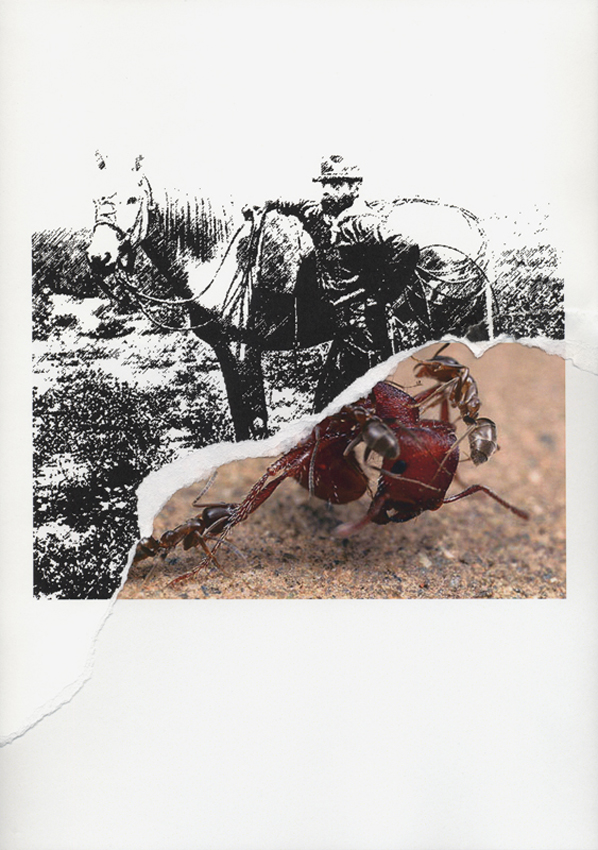
Gaucho-k

Crossfade, c-print-collage A4 – Mario Asef © 2012

.

Changing the Social Organisation

In the early phase of the invasion of South America the Europeans were friendly and cooperative to each other. But as soon as the continent was under control, the different European nationalities started to fight each other. Since the nineteenth century national associations of immigrants in Argentina strained to soften the process of adjustment. Different European communities such as the Basques, Catalans, Italians and French united in mutual aid societies and groups. The new ideas that came with the migrants from Europe led to the rise of the labour movement and allowed for the emergence of anarchism, socialism and syndicalism.

While Argentine ants from rival nests normally fight each other to death in their original habitat, Argentine ants from the super colony in Europe have the ability to recognize each other and to cooperate even if they come from nests at opposite ends of the colony’s range.

The Linepithema Humile is a polygynous and polydomous species which means that one colony can have more than one queen and several habitats. And so, when workers from different colonies meet they do not treat each other as rivals which provides the Argentine ants an evolutionary advantage over other ant species.

comando-k

Crossfade, drawing A4 – Mario Asef © 2012

.

The Social Stomach

(Mate)

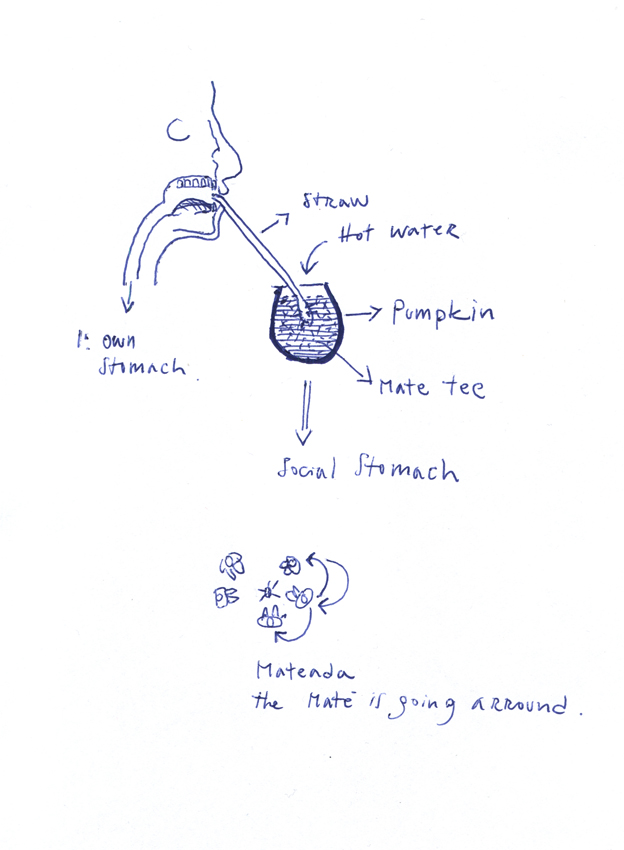
This drink is made from infused dried leaves of yerba mate (holly Ilex paraguariensis). The term “mate” originally referred to the drinking bowl (from the Quechuan term mati, bottle gourd), but is today used for the drink itself. Drinking mate is traditionally a social event around La Plata River. It is served with a metal straw (bombilla). When mate is drunk in a group, the same bombilla is travelling from mouth to mouth. Mate is offered to every visitor, traveller or friend as a welcoming gesture. Drinking mate is a communicative practice which offers an exchange of information among the participants.

(Crop)

An Argentine ant has more than one stomach. One stomach is for itself, while the other is the crop that is used to feed others. With their mouths pressed together the ants feed each other. The food comes out of one ant‘s crop and into the other ant‘s mouth. Pheromones come with the food and are exchanged as well. They keep information on needs, excitement or danger. Pheromones can also create a bond or friendship between colony members, helping them to work together.
mate-k

Crossfade, drawing A4 – Mario Asef © 2012

.

Impact on the Environment

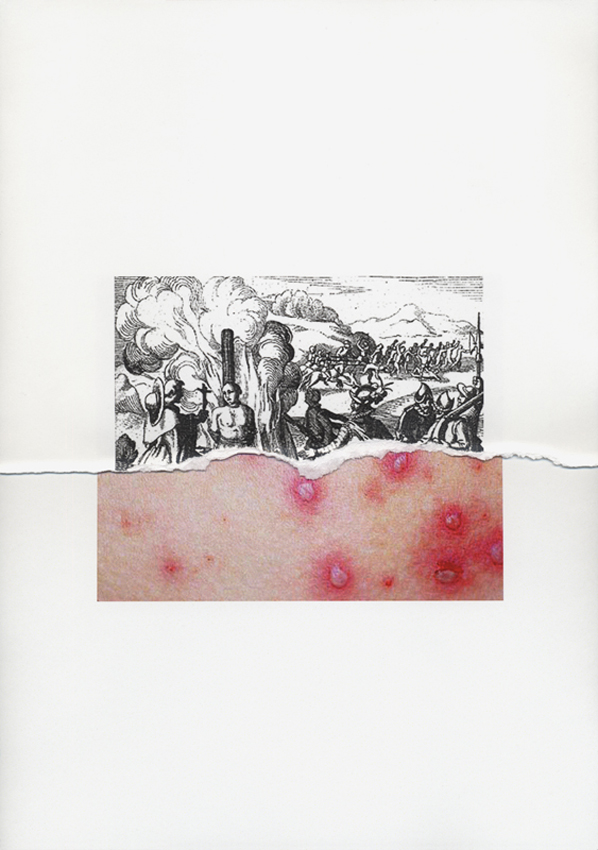
The death of millions of indigenous people during the years of the colonization of South America and further periods of European invasion was not caused alone by physical violence. The massive death rate, which decreased the indigenous population by 90 percent, was also due to diseases like influenza and chicken pox, which came with the invaders. In addition to this, slavery was another important aspect of the high native death rate, where indigenous people died because of bad nutrition and hard labour.

The Argentine ants have made a severe impact on Europe’s ecosystems. They have conquered and monopolized the land of South European ant species because of their social rules: The Argentine ants drive out or kill the native ants of a newly invaded territory and steal seeds from their beds. As noted by Laurent Keller of the University of Lausanne, Switzerland: “Cooperation allows the colonies to develop a much higher density than that which would normally occur, eliminating some 90 percent of other types of ants that live near them”.
windpocken-k

Crossfade, c-print-collage A4 – Mario Asef © 2012

.

Conclusion

Human migration is often caused by extreme conditions. Migration is used as a strategy to survive or to obtain a better quality of life. This is the reason why people from areas with lower resources and higher competition emigrate to areas with higher level of resources. The majority of immigrants in Argentina came from Europe, mostly from Spain and Italy but with a substantial influx of British and Germans. Also notable are Jewish immigrants escaping persecution. The total population of Argentina rose from 4 million in 1895 to 7.9 million in 1914, and to 15.8 million in 1947.

The extreme domination of certain species within an ecosystem shows clear evidence of a system out of balance. The Argentine ant marked the ecosystem of the European Mediterranean coast to such a degree that the notion of that Area without Argentine ants influence will be inconceivable in the future. It is men who probably created the ant mega-colony by transporting the insects around the world and by continually introducing ants from three continents to each other, ensuring that the mega-colony continues to grow.

zufall-k

Crossfade, drawing A4 – Mario Asef © 2012
Faraway, So Close!

Carolina Jiménez

Boersianer-Diagram-negativo
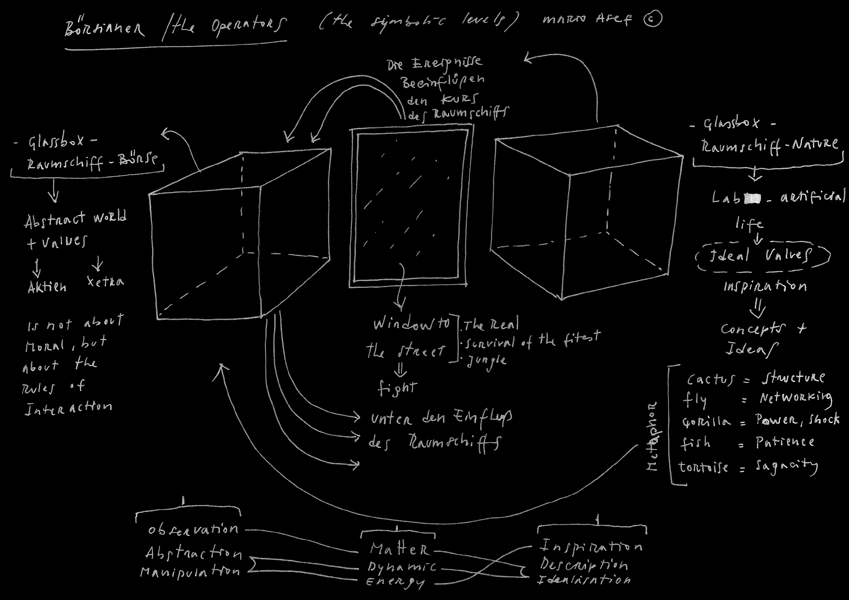
Börsianer / The Operators, diagram – Mario Asef © 2009

Mario Asef’s first studio visit with Node’s resident curators was, for me, one of the most motivating moments of these ultimate months. It was the last studio visit of a long rainy Berlin day. The eight of us were exhausted and immediately ‘occupied’ the green carpet of Mario’s studio. What could have been an awkward meeting (because of our tiredness), instantly turned into an extraordinarily appealing talk. Every piece of work he showed us led to a conversation about several topics, sometimes related to art, sometimes to philosophy, politics or social relations. When the visit finished most of us felt the need to somehow try to work with him. We wanted “more Asef”.

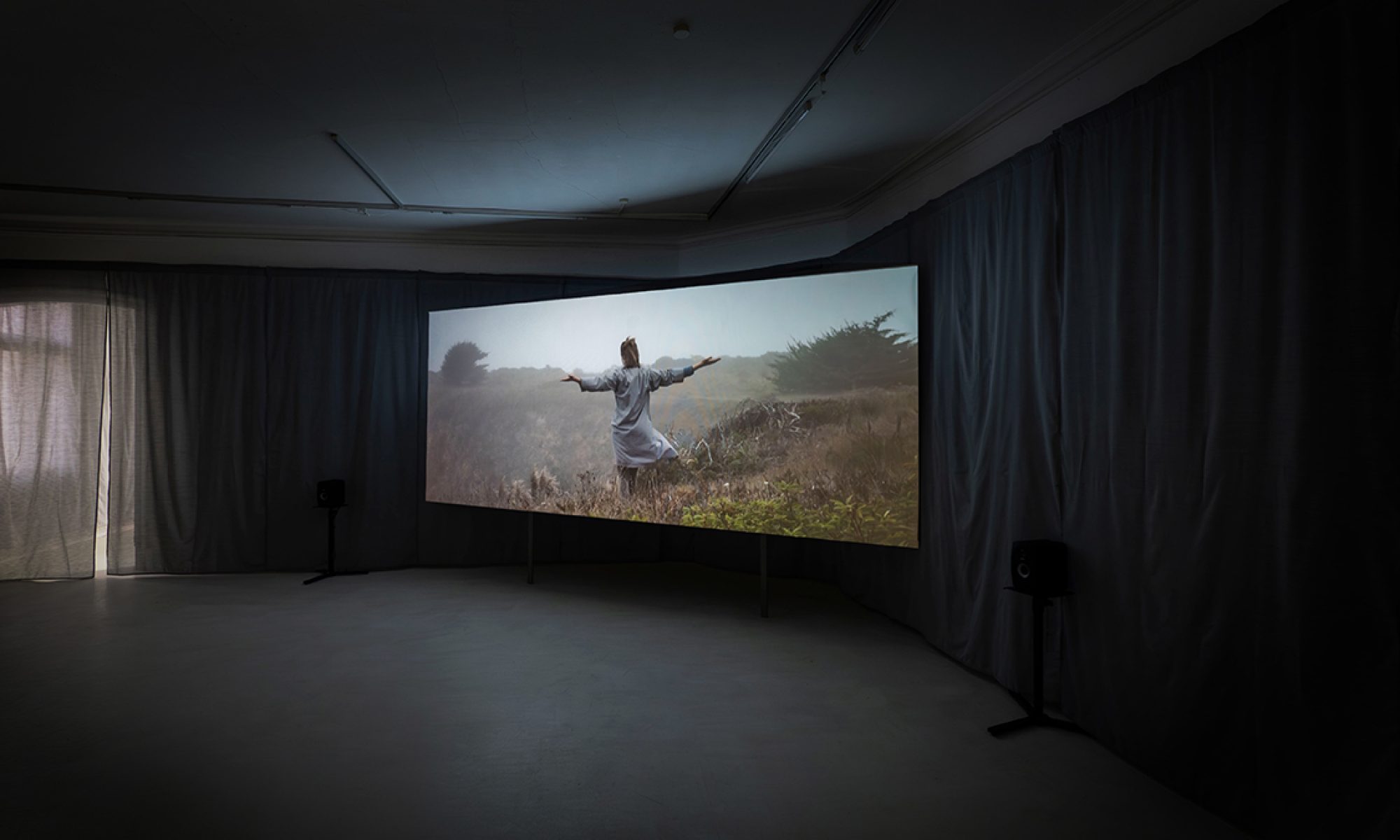
For Faraway, So Close! we selected three pieces from Mario Asef’s video series History is now: Börsianer/The Operators, Man’s on Moon, and Revolution after Revolution.

In his videos, Asef brings us back to the concept of intra-history, introduced in 1895 by the Spanish philosopher Miguel de Unamuno in his book En torno al casticismo or to the most recent vision of micro-history by the Italian Carlo Ginzburg. For Asef, history should be interested in the routes whose principle leading roles are played by its peripheral actors; that is to say, the paths followed by those men who make history in an unconscious manner, by those who do not aspire to the title of heroes. The historical event is not the monumental fresco that encourages the mythification of politicians, military men and priests, the traditional heroes of history… Mario Asef decodes these concepts, recovering “micro-historical moments” (as he points out) in order to reveal the present as historically significant. Börsianer/The Operators juxtaposes the apparently sterile composure of the Frankfurt Stock Exchange with the life of homeless people from the suburbs of the city. What at first sight could be regarded as two antagonistic worlds become the two sides of the same instinct of survival. Abstract values versus reality? Civilized world versus wilderness? Every downturn of the financial market becomes crucial to our lives, as nature is experienced as an all-embracing fact and dictator of reality… like the bucolic backdrop shown through the glass of an aquarium.

Skizze
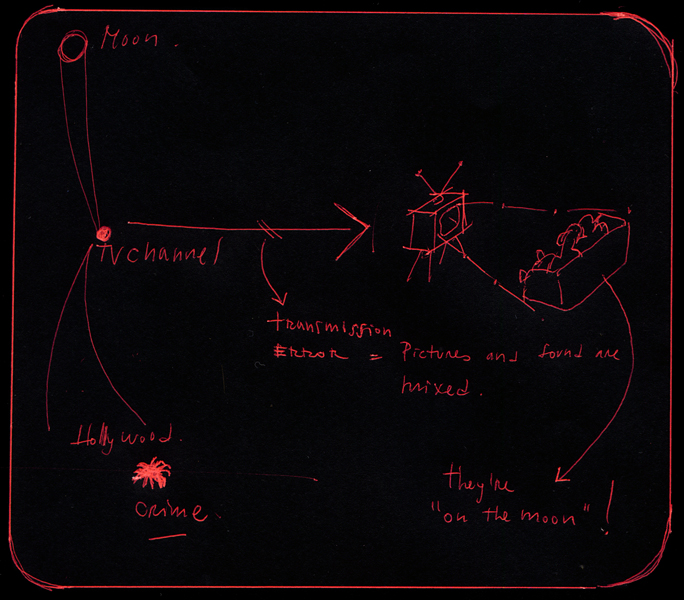
man’s on moon, diagram – Mario Asef © 2006

Man’s on Moon looks back to 1969, when Commander Neil Armstrong became the first man on the moon. This scene, broadcasted to every television of the Western world, incarnated the faith of our civilization in technology and science during the Cold War era. In the same year, one of the most feared serial killers of America, Charles Manson, was arrested. His arrest marked the milestone of the end of the hippie-era, the end of Martin Luther King’s dream… In Man’s on Moon, Asef cuts together sequences from the Apollo 17 Mission and audio extracts from Charles Manson interviews, reflecting on the social dynamics that lead to an ontological discussion of truth and reality.

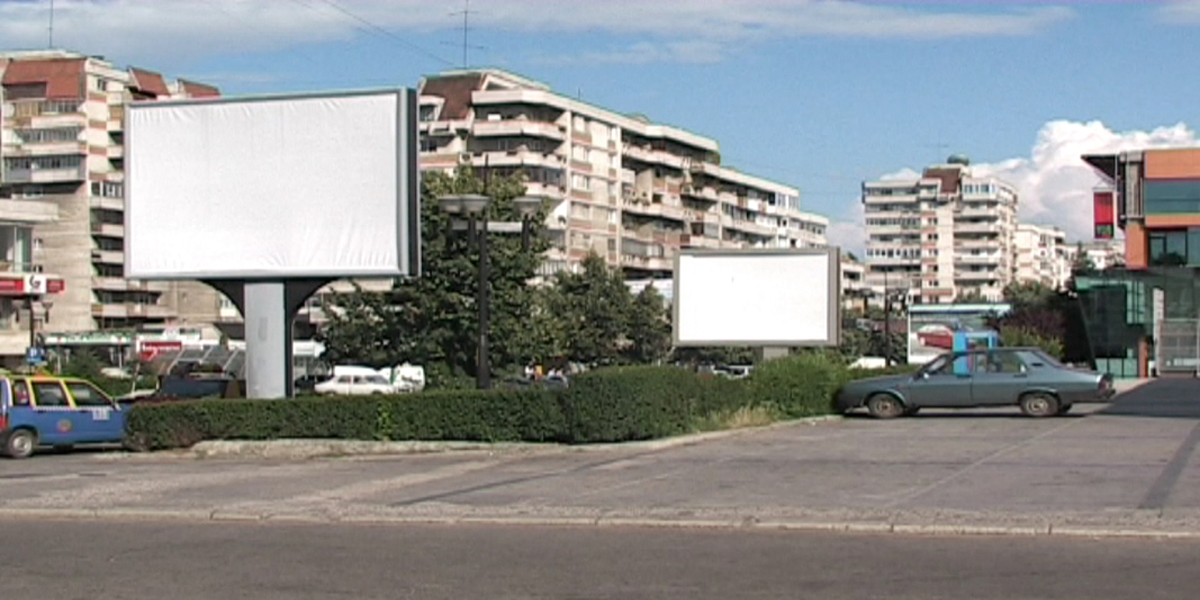
In the words of Asef, “when a staged revolution is part of a country’s historical reality it shapes the direction of everyday life”. Filmed in three Romanian towns (Sibiu, Pitesti and Bucharest), Revolution after Revolution examines how advertising strategies of the post-Communist era are digested as part of Romanians’ everyday lives. The modern architecture of the sixties and its dead ideology forms the background where citizens become actors (or heroes?) and revolution turns into allegory.

revol-groß
Revolution after Revolution, video still – Mario Asef © 2006

The illusion of security

“We are not content with negative obedience, nor even with the most abject submission. When finally you surrender to us, it must be of your own free will. We do not destroy the heretic because he resists us; so long as he resists us we never destroy him. We convert him, we capture his inner mind, we reshape him. We burn all evil and all illusion out of him; we bring him over to our side, not in appearance, but genuinely, heart and soul. We make him one of ourselves before we kill him. It is intolerable to us that an erroneous thought should exist anywhere in the world, however secret and powerless it may be. Even in the instance of death we cannot permit any deviation… we make the brain perfect before we blow it out.”
George Orwell, 1984

Priorities seem clear: first learn, then understand, and finally accept. The whole purpose here is not repetitive or blind obedience but disciplined and controlled minds… George Orwell could not anticipate the economic globalization and the sophistication of information technology in the Western world, but he formed the basis for understanding some of the most serious problems we face today.

Living in a contemporary world means to be surrounded by a multiplicity of electronic devices that gradually shape new borders of our personality. We expand and consider our private space to be inside our iPhones, computers and mailboxes. This unreal and imaginary possession of information can lead to manipulations, performed not only at an individual level. In particular, the lack of corporate and governmental transparency has been a topic of much controversy in recent years, yet the only tool for encouraging greater openness is the slow, tedious process of policy reform.

The Transparency Grenade by Julian Oliver for Studio Weise 7 was the central pivot on which the exhibition in the Fichte-Bunker turned around. It represented two actions: firstly, the invention and construction of an electronic device, and secondly, a situation. The Grenade itself was a replica of Soviet F1 Hand Grenade with a different mechanism of destruction, equipped with a tiny computer, microphone and powerful wireless antenna. It was also a situation, because it made the viewer directly responsible for pulling the ripcord to detonate the Grenade in order to unmask the decision-making processes of any corporate or Governmental Institution. Email fragments, HTML pages, images will be revealed, reminding the occasional user of his weaknesses and strengths. As stated by Michel Foucault, the individual is a part of the power structure’s cogs and secures it with his own attitudes and behaviors. However, and it may seem contradictory, this power (as read in George Orwell’s1984) is omnipresent and omniscient, a power that is constantly being apprehended, but which never answers. State institutions are mechanisms that seem to obey their own laws and rules, they are bureaucratic labyrinths completely unknown by us. Thus, we find depersonalized individuals facing an apparatus against which there is no way to oppose. Numerous references were forwarded about this in Faraway, So Close! by Argentinean artist Mario Asef, especially in the video piece Börsianer / The Operators, which juxtaposed the apparently sterile composure of the Frankfurt Stock Exchange with the life of homeless people from the suburbs of the city. What at first sight could be regarded as two antithetical worlds became the two sides of the same reality. Every downturn of the financial markets becomes crucial in our own lives…

The viewer inside the Fichte-Bunker was confronted with a dystopic reality, a world not desirable, but conceivable. John Stuart Mill coined in the last years of the nineteenth century the term “dystopia” to refer to an unwanted society, opposed to utopia. Mill described an oppressive and closed-on-itself society, usually under an authoritarian government, but presented to its citizens as a utopia. George Orwell’s 1984 was one of the most refined examples of dystopia. It insisted, in a very persuasive way, on the power of technology as a basic tool for social control and the end of privacy. Orwell portrayed a society that to survive, created a perverse, permanent monitoring system from which originated an increasingly imperceptible but ever-present control, a subtle and not clearly coercive method that left citizens with the permanent doubt of whether they were being watched. It is through the uncertainty of not knowing how to maintain the subordination of being under surveillance, through a large and always-on screen, receiving and transmitting information, that individuals were handcuffed by their actions. All this, centralized by the everpresent Ministry of Truth, which was a pyramidal structure of white concrete over three hundred meters high. The Ministry of Truth acted as a vast Jeremy Bentham style panopticon that distinguished, watched and controlled all of what happened in that society.

According to Zygmunt Bauman, uncertainty about the future, the fragility of our social position and the anxiety of our own existence are persistent elements of our society. Therefore, one of the basic actions of human beings has been to preserve the order and to ensure its durability from incursions coming from the outside: an “outside” characterized by disorder and insecurity; an exterior that, in each historical moment has had different characteristics and traits, but always an enemy, an enemy that has always been the “other”. Against this “other”, that represents the fragility and the precariousness of daily life, all societies have been provided with multiple defensive tricks and tools that allow us to preserve, keep the acquired and make it our own. In this way, any risk must be eliminated in order to procure a comfortable place in a world that shows itself as threatening and hazardous. Uncertainty and confusion have increased with the rapid changes in recent decades of new information technologies and globalization. Cities, urban areas and transport are no longer safe places and have become a major cause of worry and insecurity. Now spatial structures conceived to isolate, exclude, reject, resist, camouflage, and absorb have been encouraged.

The need and desire to feel safe in today’s world has become a handy justification for the implementation of measures that threaten the foundations of democracy and social life. It is odd that cities had never before counted on so many security measures, but never before the feeling of insecurity has been so present. Agreements have been made, according to city planner Peter Marcuse , in order to promote the physical 1 “bunkerization” of space (controlled indoors, such as shopping malls or office buildings, containing within them all the facilities necessary to work, eat or relax) up to the social “bunkerization” of all democratic activity (the limitation of movement, freedom and action, the decline in social and political participation, the growth of exclusion…). This creates new sociopolitical realities where security is exchanged for a restriction of freedoms. Power needs a fearful, insecure and vulnerable society. To keep it, people have to be submissive and in this way consolidate the power’s efficiency. However, we cannot forget that the expression of power is becoming less and less visible, and therefore its influence is difficult to recognize, to anticipate and bear up. The exercise of power is gradually more elusive and insidious, it is everywhere and nowhere, it is ubiquitous, absent, invisible… To this wicked and endless game, that creates fear and creates, at the same time, many and various systems to control it, also referred Faraway, So Close!.


Carolina Jiménez

1) Peter Marcuse, After the World Trade Center. Cuadernos de arquitectura y urbanismo, Barcelona. 2002

The Author

Carolina Jiménez, (Madrid, 1983). Journalist and cultural manager. Lives and works in Berlin. As a political journalist, she has worked in Spanish media like Cadena SER, Agencia EFE and Temas magazines. In the cultural sector she collaborated with contemporary art centers such as Matadero Madrid or La Casa Encendida in Spain. In 2012 he moved to Berlin after being selected to participate in the residency for curators of Node Center for Curatorial Studies. In Berlin she has curated the exhibitions Faraway, So Close! at Fichte-Bunker, We Can Draw It in GlogauAir and Coversation With Alice in Altes Finanzamt. He has been coordinator and manager of SAVVY Contemporary, award for best independent space Projekträume 2013  by the Senate of Berlin (Berliner Senat). She is currently in charge of the communication at Node Center for Curatorial Studies-Berlin.