Mario Asef‘s public interventions, photographs, videos, soundscapes and installations focus on the legibility of urban space and architecture within a specific sociocultural and historic context.
Seeking to explore intimate socio-critical and political aspects of forms, the artist constructs a narrative system, a thought experiment that aims to produce an unpredictable effect - a moment of logical absurdity - creating a fiction of the real. He is a precise and yet poetic recorder of the fleeting and the mundane. His work emphasizes, in an unpretentious way, moments of displacement and the disappearance of space and time. In a subversive and humorous way, Mario Asef manages to breach the rules of the every day life. Like a researcher he explores, by way of different mediums, the interdisciplinary construct of public spaces and public life.
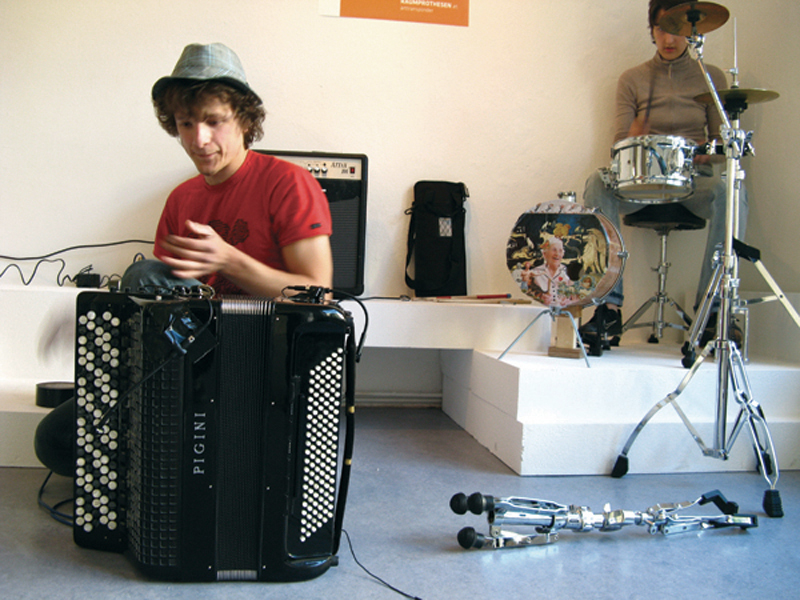
The opening of Mario Asef’s exhibition Raumprothesen für frei zusammenwachsende Sozialorganismen (Spatial Prosthetics for Freely Integrated Social Organisms) at arttransponder was a big celebration. As announced on posters in the exhibition space, various Berlin-based street musicians, invited by the artist, played one after the other. The musicians hailed from northwest Africa, Turkey, and Russia, and also included a World Music DJ from Argentina. Toward the end of the night the musicians spontaneously improvised together. For viewers the gallery visit became a musical journey through world cultures whose sounds and voices became increasingly mixed over the course of the evening. At first the musical event seemed to be the focus here, however, during the remainder of the exhibition the essential conditions and multi-layered referential structures of the project became evident.
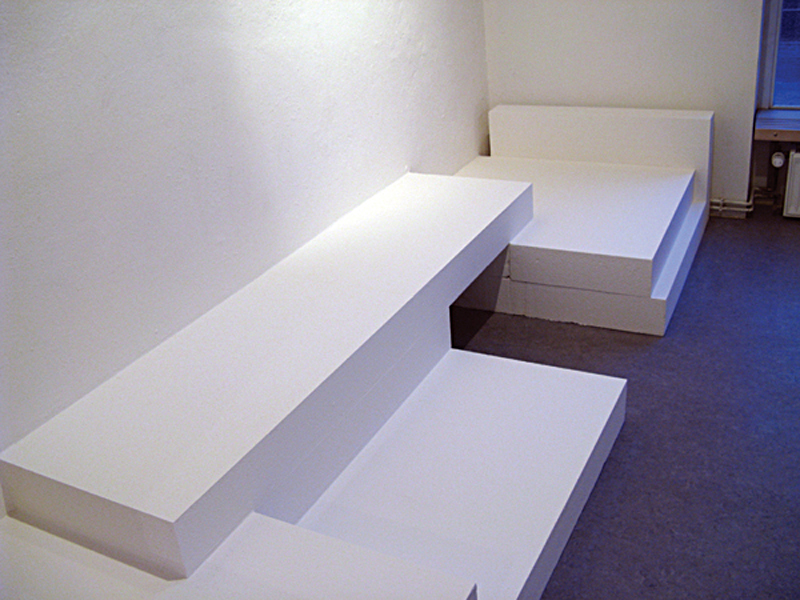
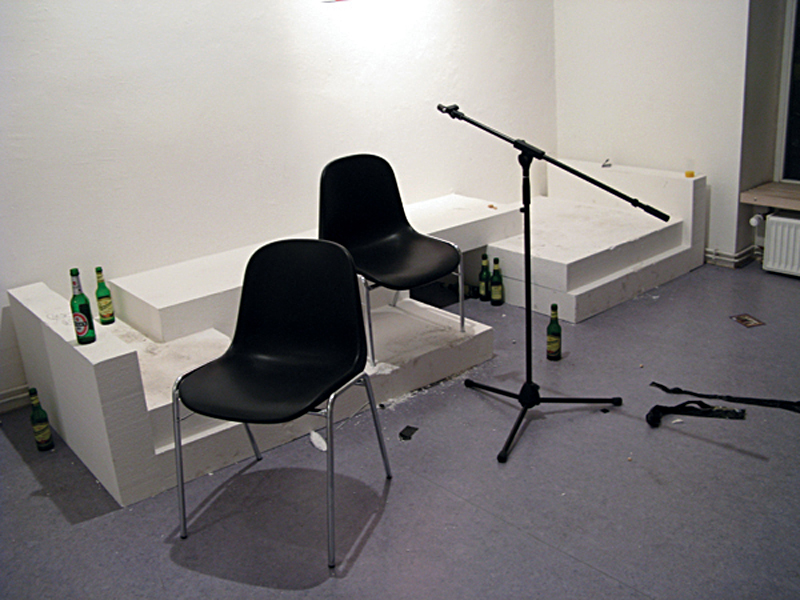
The “Raumprothesen,” which give the exhibition its name, served as individual stages for the musicians. Made out of insulation board, the abstract geometrical shapes in the form of ledges and steps inconspicuously extended the stark architecture of the White Cube into the space. While the artist-designed objects that add to the existing architecture are certainly a focus of the exhibition, their designing points more significantly to a symbolic shifting of the categorization-defying architectonic remains—which Mario Asef groups under the neologism “Raumprothesen”—from the realm of urban public space to the (institutional) art context. In the sense of the dualism of Site (here: public space) and Nonsite (here: gallery room), once formulated by Robert Smithson, a kind of displacement also occurs here that changes our perceptions. Both of Smithson’s terms also explicitly refer to their respective phonetic equivalents of Sight and Nonsight: what consciously enters our field of vision first affects us and holds our attention. Shifting the Raumprothesen from urban space to the gallery space leads therefore not only to a revaluation of these elements, which are completely neglected—if not repressed—by city planners and architects, but generates literally and figuratively a platform for street musicians. In one’s perception of public space, illegal immigrants are—like some of the participating musicians—often degraded to objects that seemingly belong to the cityscape. Shifting the location of the musicians also signifies for them, in analogy to the Raumprothesen, a revaluation of their musical playing and their recognition as subjects of our society. If insulation board typically functions to isolate rooms acoustically, the voices of immigrants are now the focus of attention on top of them.
This new form of public appearance didn’t seem to put all of the invited guests at ease; the fact that the Romanian musicians didn’t even show up for the opening night might be an indication of the explosiveness that goes along with this shift. The White Cube as an exclusive space closed off from the outside world becomes itself a far more open platform here; the borders between the experience of art and the urban everyday are permeable. Thus everything that transpires in the exhibition space also always points to its external reality. At the same time remnants from the opening night, such as scattered beer bottles or candy wrappers, become a part of the work as much as they are an index of a prior and potentially missed event. These can be appreciated during the concert-free period with a video from the opening celebration that plays on a small monitor in a corner of the room. Via this shift in medium a direct relationship is made to the video work Violinparis (2007)—presented at the same time in the exhibition—whose symbolism forms the point of departure and the basis of the questions being addressed here: with very little concern for technical effects and no subsequent editing, Violinparis presents the portrait of a Parisian street musician who plays her Turkish Rebec undisturbed and uninterrupted in front of the Centre Georges Pompidou while museum workers busily measure the square around her without paying her any attention. Over the years she has, as a matter of course, become a fixed element of the square, the sound of her instrument has become the constant soundtrack to local events. If, at best, she makes waiting in line for the Centre Georges Pompidou easier to deal with as a result of her playing, then in an exhibition context she is granted a presence and recognition that she hardly ever benefits from in everyday life—even if, or precisely because, a surprising number of visitors remember her from their visits to Paris.
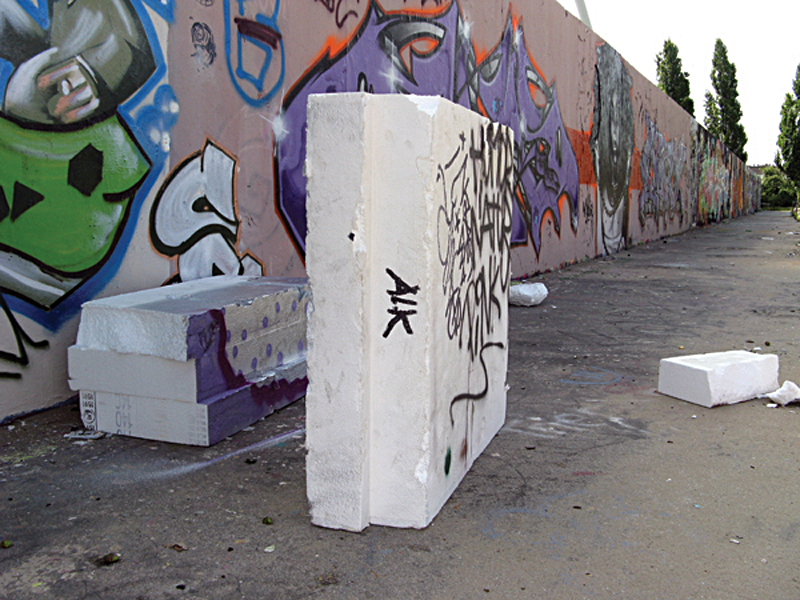
In a final action at the end of the exhibition, Mario Asef converts the here-mentioned shifts into a circular flow, thus turning the previously ideal repercussion of this project on external space into a material. As an art object, but mainly as prototypes of architectonic blank spaces, he places the slowly disintegrating insulation board-constructions in central locations around Berlin such as Potsdamer Platz, Alexanderplatz, and Mauerpark, reintegrating them (back) into urban space. They become a part of skateboard ramps, incorporated into graffiti, or used for seating. Now it’s only a question of time how long the impermanent material can hold its own ground.
Via this intermingling of two distinct spaces, each with their own inherent social customs and unspoken rules, Mario Asef’s exhibition project Raumprothesen für frei zusammenwachsende Sozialorganismen ultimately becomes itself a test case for urban development. A test case that demands a new way of looking at our architectonic surroundings and social interactions—both in the urban environment as well as the exhibition space.
Fiona Mc Govern studied art history and comparative literature in Göttingn and Berlin. Since Spring 2009 she is a research associate at the collaborative research centre Aesthetic Experience and the Dissolution of Artistic Limits, Freie Universität Berlin and works on the adaption of curatorial approaches by artists since the late 1960’s.
Sabeth Buchmann – Mario Asef about EMPIRIEN a series of interventions in public space
Sabeth Buchmann: It would be relevant to discuss your work in relation to so-called social minimalism. This term refers to standardized forms of work with an industrial aesthetic that is based on historical minimalism and that-as in so-called institutional critique and the so-called context art of the eighties and nineties-is loaded with socio-cultural significance. Examples include the works of Janine Antoni, Angela Bulloch, Tom Burr, Felix Gonzales-Torres, Henrik Olesen, Christian Philipp-Müller, Heimo Zobernig, etc. In my opinion, one certainly can make these associations, alone due to the apparently alinear structuring of the concepts of your work-which are rooted in the work world and everyday life-according to typologies that are more or less randomly compiled according to letters of the alphabet.
Mario Asef: From the very start the interventions were conceived as a kind of journal, in which chronology played a deciding role. In retrospect, I discovered that the series contained very specific themes, in which the intervention assumed a specific position and which, to a certain extent, demonstrated a continuity within the timeframe of a year or longer.
Naturally these themes do not need to be organized in a linear manner. There is no reason why one theme should come before or after another. The format of the book as a medium does favor a linear reading of the works. For this reason I resorted to a random classification of these themes, in order to refer to and create awareness for the non-linear coexistence of the different thematic areas.
On the one hand, this highlights the fact that a certain kind of knowledge that one acquires through experience (Empirien) is not stored chronologically in the memory. It is abstracted in a way that space and time exist independently of one another. On the other hand, herein lies a negation of conventional historiography, which always runs counter to psycho-physical element of memory in order to represent a constructed, linear xobjectivity towards events-which ultimately only serves a political aim.
S B: The kind of terminology you bring into play –Empirie and the notion of experience-seems to formulate an opposing stance to the minimalist tradition related to conceptualism, in which the artwork is based on ideas or theoretical propositions. At the same time, one is not given the impression that you are interested in the aesthetic or phenomenological experience in your work but in experience as a form of information about the specific context in which the works are placed. My question is whether you are concerned here with opposing moments in the perception of the xobjects and situations you construct?
M A: Yes, I do try to clearly separate different stages of perceiving the work. I think there are different levels of experience. This term is normally reduced to a sensitive level, in which an immediate effect is ostensibly generated through confrontations with the material world, without an impact on other mental levels. However, there is also a level of “mental experience,” in which material is charged with certain signifiers that strongly influence experience and that can generate different kinds of perception, depending on the possibility of interpretation in socio-cultural contexts. [All such knowledge can be confirmed as true or false, so that one single experience can be associated with multiple, and perhaps even contradictory, meanings.]
My working process consists of setting up a hypothesis in mental space and then looking for an experience in actual space that can confirm this hypothesis. In other words, this reverses the empirical process through which knowledge is gained, and thereby the function of a “contemplative action” is artificially generated and pursued ad absurdum.
Thus, an idea is not created from experience but implanted within experience as an abstract thought. Idea and experience thus becom e a systematic construction of a thought experiment that aims to produce an unpredictable effect.
S B: To what extent would you say your approach is related to project formats that circulate under the term artistic research? This includes an almost scientific investigation of locations, contexts and discourses. I am asking this, because, on the one hand, you often work with text and commentary; on the other, you seem to place value on the literary and poetic quality of your xobjects and projects-a quality that analytical research projects sometimes lack. So here are two questions in one.
M A: These works are not based on any kind of research project. This analysis normally develops as a kind of assimilation process. We know that the analysis cannot continue to exist independent of an xobject of investigation. This means that the analysis exists as a whole and can therefore very quickly lose its relationship to empirical reality and remain unaffected by it. In order to disempower the analysis, one can use analysis itself as a means of establishing a critique of the analysis. In this sense, humor plays an important role in my work.
The basic idea is to create a system within which one can move more or less freely. For this purpose I often fall back on pseudo-scientific methods, always in the hope of achieving a poetic sensibility that lies beyond this methodology.
This might sound paradoxical. However it is true that science (particularly since the beginning of the 20th century) has strongly influenced the cultural imaginarium of the Occident (here one could include Cubism or Futurism in conjunction with numerous science fiction visions, etc.). In other words, it is fertile ground for poetry. New scientific discoveries open up new perspectives on life and also new fantasies.
S B: Maybe we can use this point to delve more concretely into the sculptural aspect of your work. I have the impression that you-although your works could best be described with the term “situation” or “situative intervention”-still hold onto what one could call a classical approach to the xobject. For example, in the intervention Europe Towers, which you realized in a Bausch & Lomb warehouse, you bring together the aspect of a new order within European norms and a reference to modular typological forms of modern architecture, and at the same time you use cardboard boxes. The association with Warhol’s serial xobjects and minimalism is obvious. Are you interested in pointing to the frame of reference in which you are operating, i.e. the institution of “art?” At the same time, you interventions are apparently always located outside of this frame of reference, in the factory, on the street and in contexts that impact “other” social levels and realities in order to engage there with genre-like conditions of artistic production.
M A: Although a clear reference to the art context is implied in my interventions and precisely because the transformative significance of xobjects play an important role in my work-xobjects that are taken from everyday life into a gallery and museum and are then again returned to the street-I do not want to define the formal element of my work as sculpture but as structure in public space, as converted elements of this public realm that have taken on artistic reference through a “shift in order.”
One should also consider the fact that precisely these references function contextually. That is to say that once the documentation has been put together, the works must be shown in an institutional space in order for them to evoke the artistic references that were a consideration in the working process but do not play a role in the initial confrontation with the intervention.
It is really important to me that all xobjects undergo an additional process of transformation. Only in this way do such interventions have meaning.
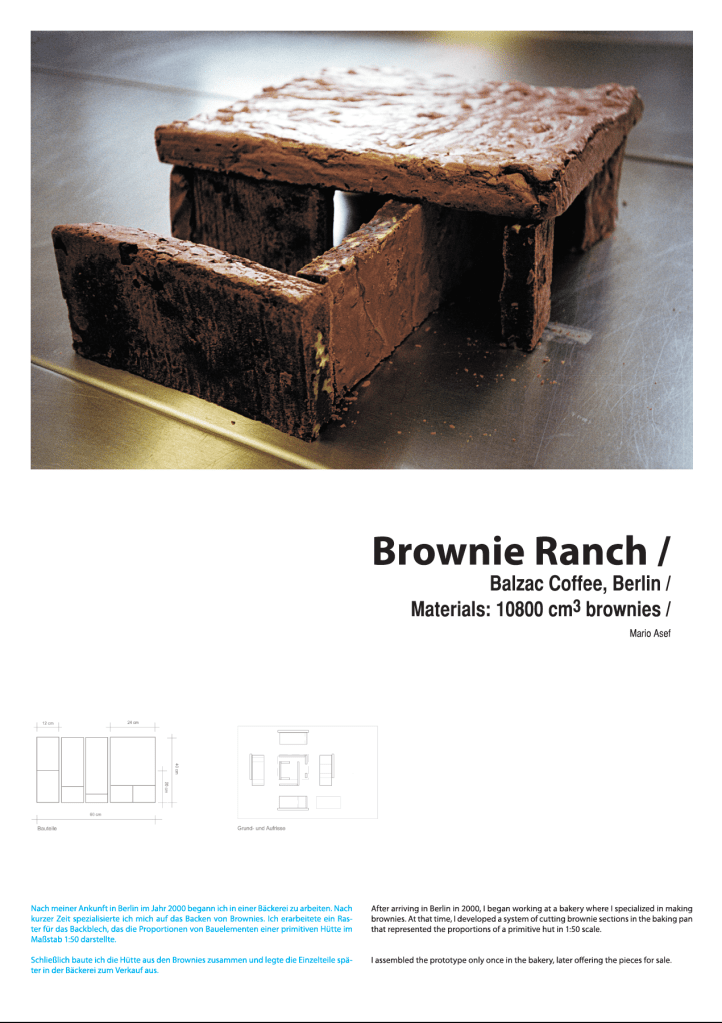
S B: A conspicuous element of all the concepts of your work is that they always contain a moment of retroactive impact that is mediated through the documentation: that means that different sites of intervention-such as in Brownie Ranch, Job Center, etc.-always function as a mediated site for the production of signs. However, this is exactly what seems to make it possible for you to integrate an act of chance in a specific way-an act that embodies the moment the work is perceived. In this context I am thinking of the work Mudança. This raises the question of whom you want to address in your work.
M A: In the first phase of the process the addressees are always passersby. Later the work shifts more in the direction of addressing the viewers and consumers of art. They all represent the corpus of the social, and in this way they all represent the intended audience. In other words, the interventions consist of reorganizing elements in social space. The passersby, users, clients or workers who happen to be at the places I have selected rearrange these elements or simply destroy them.
Initially this kind of participation is the catalyst for nonverbal communication outside cultural institutions, and it represents a kind of transgression of the artistic context. Later the works are documented, and this documentation is shown as art in an institutional context. As a result, the range of addressees becomes wider, and the relationship to the work is changed, because the reorganized elements have already vanished and they only remain as a kind of “staged memory” (documentation) in the gallery or museum.
S B: In conjunction with my previous questions I am interested to know whether you have certain specific artistic conventions in mind when you take photographs, or whether you tend more towards a journalistic style.
M A: All interventions were documented with an analogue pocket camera. Personally, I have no photographic ambitions. My position resembles that of tourists who are always outside of the contexts in which they find themselves and who try to make sense of the given situation from a distance. This distance resembles the rhetorical distance of a poet, the mathematical distance of a scientist, the structural distance of an observer. At the same time, I try to engage with the paradoxical realm of the photograph. As in Dead Policeman and Hole, in which the significant motif within the context remains positioned behind the camera. The location was namely a US military base, and, as is the case at such sites, one is not allowed to take photographs.
Or in Fragile, in which a comedian placed himself in front of the intervention after it had already been taken over by homeless people. The public photographed the show and also the appropriated intervention in the background, which remained “invisible” to people because they didn’t know about it. This means that the motif of my intervention was reproduced dozens of times, but it remained invisible to people.
This phenomenon is repeated in the many interventions of Type L, in which people simply shoot photos in a museological context in order to look at them in peace and quiet at home. However, when they get home, they realize that these locations where they have been did not correspond to what was represented in the photographs. In other words, some elements take up previously unsuspected positions, although everything still looks completely ordinary.
S B: It is almost a banal cliché to say that the function of art consists of making something visible. As if the field of visibility were a privileged field of work. Your work seems to be concerned with opening up other possibilities of perception. We talked about this initially in reference to the notion of information, which targets cognitive or intellectual elements. Here, I primarily mean your work with literary texts, such as those of Borges, which deal with a transformation of language itself in a way that is more or less implied in all of your interventions.
That brings us to Marcel Duchamp, who comes to the fore in Type L, your act of donation: here information and language refer to the museum’s classification of apparently non-aesthetically coded xobjects. One could also draw other parallels, for example to Beuys and Broodthears, in the sense of a reflection on the meaning of exhibiting and the associated institutionalization process of modes of production and understanding. What would you like to add to this reflection?
M A: These kinds of references to Duchamp or Broodthaers are certainly an aspect of my intentions, although my interest is more concentrated on the aspect of the classification systems for xobjects in our environment. Thus, these interventions represent a parameter for the classification of private xobjects, which generate an absurd moment when combined with the predominant value parameters of our culture. That is the reason that we laugh when we think about choosing to make a differentiation, and it recalls Jorge Luis Borges story The Analytical Language of John Wilkins, in which he presents a list of the classifications of animals in a Chinese encyclopedia.
So my works speculate with the notion of creating a Museum of the Absurd, in which the exhibited items provoke new chains of reactions due to specific constellations, such as those of museological grammar.
Over the course of the history of art we have learned that every xobject is a carrier of meaning for cultural signifiers. Why not rethink the traditional encyclopedic structure of our museums and reconceive it as a porous organism in which public interaction is a source of a continual reconstruction of the institution?
Sabeth Buchmann is an Austrian art historian and art critic. Currently she is Professor of Modern and Postmodern Art and the Head of the Institute for Art Theory and Cultural Studies at the Academy of Fine Arts, Vienna. She contributes to books, magazines and catalogues. Her publications include Film, Avantgarde und Biopolitik (Academy of Fine Arts, Vienna, 2009) and Art After Conceptual Art (The MIT Press, 2006).
Mario Asef is a visual artist born in Córdoba, Argentina and currently works and lives in Berlin, Germany. He studied architecture and art in Argentina, Germany, and England. His work has been exhibited worldwide most recently at Junge Kust e.V. (Wolfsburg, Germany), Kasa Galerie (Istanbul), Abandoned Gallery (Malmö, Sweden) SSamzie Space (Seoul), Nouvel Organon (Paris). Recent museum exhibitions include Hamburger Kunsthalle, Villa Merkel, Kunstlerhaus Bregenz (Austria), and the Akademie der Künste Berlin.
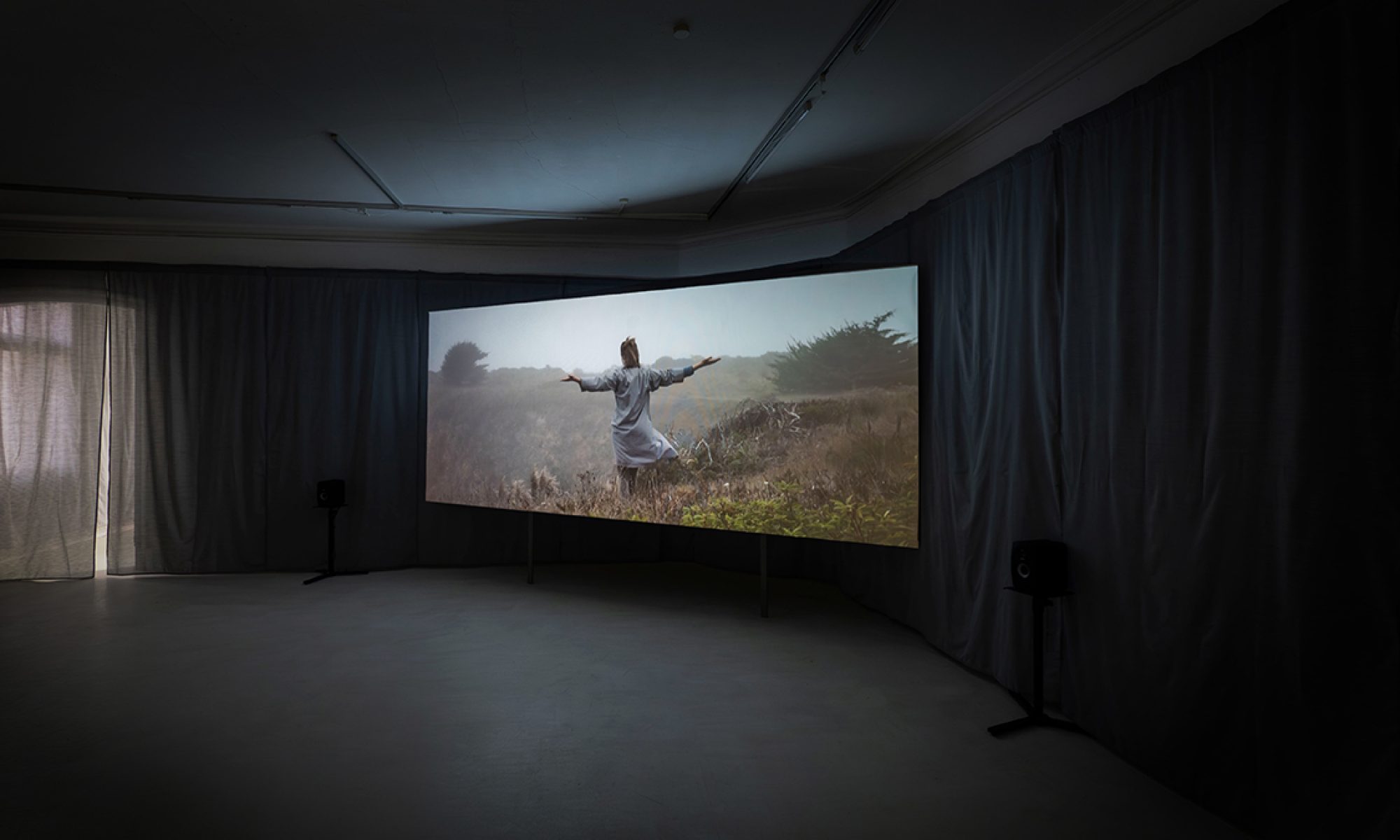
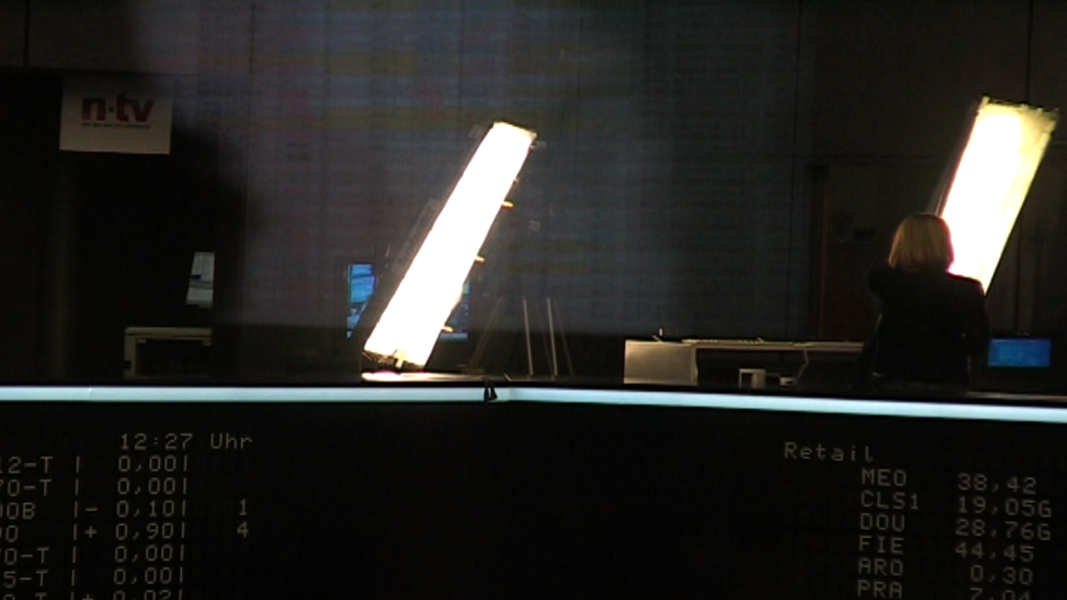
Mario Asef’s camera simply observes—it does not monitor (by recording everything in a blanket manner), it does not stare (by focusing unscrupulously), it does not gather (by picking up everything that passes before its lens), but it is just there, it observes what is happening, very directly, in the margins of goings-on and locations. It seems completely natural when a plastic bag catches its attention, following it as the wind buffets it about on a square in Buenos Aires (Edad de hielo / Ice Age, 2011). Or when it beholds a preacher for world peace at an intersection in London (Pass Over, 2003-5). Or it sits as a silent guest behind the visitor’s window at the Frankfurt Stock Exchange, registering the activities on the dreary floor in front of it and what is happening on the other side of the door outside (Börsianer / The Operators, 2009): the operators are working in the cut-throat field of global speculative trading as if in a semi-public cage, whereas those stranded on the streets are left to face its consequences with their own bodies. Images of artificial nature mediate between the agonal spheres.
The attentive gaze of Mario Asef’s camera quietly watches the everyday details of the world, thereby making it possible to draw conclusions about farther reaching injustices. Because of this his videos are not image apparatuses that produce big dramatic impressions, seduce through beauty, or seek to overwhelm the intellect. For Asef, video is first and foremost a simple technological possibility for splicing together observations of daily life, recording visual sketches, and later for tying these together artistically into complex layers of meaning. Inherent to the pensive observing of goings-on in public space is a claim to the public sphere. His videos not only address spaces and instances of authority or conquest, such as stock exchanges, revolutions, war, post-colonialism, or global trade, but they also undermine their appeal to power by showing the somewhat peripheral moments of everyday life and portraying the emptiness with signs of thoughtfulness and helplessness, with empathy, but also with humor and a sensibility for the small pleasures on the margins. In a certain sense, Asef’s particular narratives of daily experience perforate the ideal texture of a world conceived as a coherent actuality. Idea and reality are related together in a thought experiment that Asef, elsewhere, calls History Is Now.1 According to this motto, history would not be viewed as a resolved occurrence of the past, but seen as a process characterized by various temporal experiences that takes place in the here and now, without knowing what is next. It is the conception of a history that is continually transformed by stories. With Asef the historical occurrence becomes an open situation that evokes a “third text” between the signs.
“Bolsa de comercio” means stock exchange in Spanish, but an ordinary plastic bag is also called a “bolsa.” With this commerce-bag double meaning in mind, Asef follows the movements of a plastic bag in a pedestrian zone in Buenos Aires in his video Edad de Hielo. Like a tumbleweed in the Wild West, the bag careens around the square. During the eight-minute long video the object comes to life for the viewer, becomes a lung that inhales and exhales, is stepped on, pauses, and with the next burst of wind becomes active again—what existential happenstance! What’s more, a voice-over in Spanish talks about nature as the only corrective factor in man’s striving for objectivity and ends with the rhetorical question: What remains after all the acquired knowledge and various prognostications other than concrete experience? Asef observes what’s happening with the camera in order to create a situation out of them in which the viewer is able to move or think more or less freely. Therefore it is necessary to leave the stories open-ended, to not tell them all the way, to not dot all the i’s and cross all the t’s, or provide them with an ending. Asef’s videos are based on detailed observations on a sculptural level. They do not provide an overview. They present modest materials in the streets of Buenos Aires or in post-revolutionary Bucharest (Revolution after Revolution, 2005), they portray desperate moments on the alleys of Frankfurt, or dogmatic monologues from jail. The scenes of underdogs, be it people or things, are spliced together with centers of power such as the stock exchange or the lunar conquest. In Man’s on Moon (2006), for example, one sees images of the moon landing, astronauts in spacesuits and their vehicles, while Charles Manson raps in staccato against society in his typical nagging voice. Both spheres, the extraterrestrial and the outcast, are in need of a survival capsule and thus Manson sees eye to eye with the man on the moon: “I am a mechanical man.” It is about the big questions, about the spirit that animates.
Bothered by the Border (2006-8) creates an entirely difference situation. The camera shows a man singing karaoke music live on a square in the middle of people. Mario Asef had been invited to South Korea. There he visits in a park a karaoke meeting point for war veteran retirees and spontaneously sings a song. The camera is located in the crowd and shows him at times as the singer and at times the dancers beside him. Asef heightens his exotic foreigner status by singing in overtone in a foreign language. He imitates a Tuvan song from Mongolia newly set to music by the folk rock band Yat-Kha. No one understands what Asef is singing and no one is bothered by this, on the contrary, everyone is quite amused. Even a few women join in among the large number of older men. Asef later recounts that they are prostitutes who visit the meeting place regularly and are paired with the elderly gentlemen by younger men behind the scenes. Nearly all the seniors were soldiers in the Korean War, which sealed the split between North and South Korea in 1953. It is their meeting point in Seoul and Asef seeks out this particular situation. After the fact, he dedicates the lyrics of his song Bothered by the Border on the split through Korean society to this generation of fighters. The subtitles, added later, construct for us viewers a narrative space in which anecdotes are combined with tragic history in a light-handed manner.
Asef is not so interested in sociological milieu-studies or the psychological intimacy of individuals, which are often tritely put forward especially in art these days. Instead, in his videos he compiles meta-stories on the formation of narratives and history itself. Sabeth Buchmann, in conversation with the artist, coined the designation “social Minimalism”2 for his three-dimensional work, insofar as traits of historical Minimalism of the 1960s to the 90s (so-called object-based art, concept art, institutional critique, contextual art) are recognizable but are underpinned with socio-cultural meaning. During the course of this discussion it becomes clear that classifications or genre-specific categorizations are in fact possible, but for Asef (as perhaps for every artist) not really applicable. This is because he himself is always questioning art-critical categorizations as well as conventional histories, forsaking market-oriented genres, and breaking apart clichés.
Mario Asef’s video works demonstrate that history and stories belong together. In them, an artistic method is developed that makes use of oppositions to create new images in the viewer, a “third text” of open-ended interpretation, a sentiment or a mood, rather than explaining in alternation. In talking about the science of history Hayden White said: “Also Clio composes poetry,”3meaning that in representing facts analytically science also employs poetry, but its methodology does not disclose this, thus concealing its literary strategies in explaining events. Mario Asef uses, wittingly or unknowingly, the ideology critical insight of “Metahistory” (Hayden White) by uniting history with contemporary perspectives. He elevates his right to the public sphere not as a bold demand, but by realizing it with artistic methods, thereby creating visual poetry.
1 Mario Asef, History Is Now, videos: Pass Over, London – 2003/2005 – Revolution after Revolution, Bucharest – 2005 – Man’s on Moon, 2006 – Bothered by the Border, Seoul – 2006/2008 – Börsianer/ The Operators, Frankfurt am Main – 2009 – One-Euro-Land, Bremen – 2010 – Surf, 2010 – Edad de hielo, Buenos Aires – 2011
2 Sabeth Buchmann and Mario Asef, “Dialog,” in Empirien, eds. Mario Asef and BrotfabrikGalerie (Berlin, 2009).
3 Hayden White, Metahistory. The Historical Imagination in Nineteenth-Century Europe (Baltimore, 1973).
—
The Author
Dirck Möllmann *1963 – 2019
curator of the Institut für Kunst im öffentlichen Raum Steiermark, Universalmuseum Joanneum.
Curator of the Hamburger Kunsthalle 1996-2009; co-founder of VIDEO Club 99, Hamburger Kunsthalle 1999-2009; Stile der Stadt, Plattform für Kunst im öffentlichen Raum, Hamburg 2006-2012; collaboration with the Galerie für Landschaftskunst, Hamburg.
Exhibitions (selected): “SNAFU. Medien, Mythen Mind Control”, Hamburger Kunsthalle 2007, “MAN SON 1969. Vom Schrecken der Situation”, Hamburger Kunsthalle 2009, “Spring” Kunstfrühling, Gleishalle Bremen 2009; sculpture project “raumsichten” for the binationalen offenen Museum “kunstwegen” Grafschaft Bentheim (DE) and the Provinz Overijssel (NL), 2009-2012, Sadtkurator Hamburg 2018-2019.
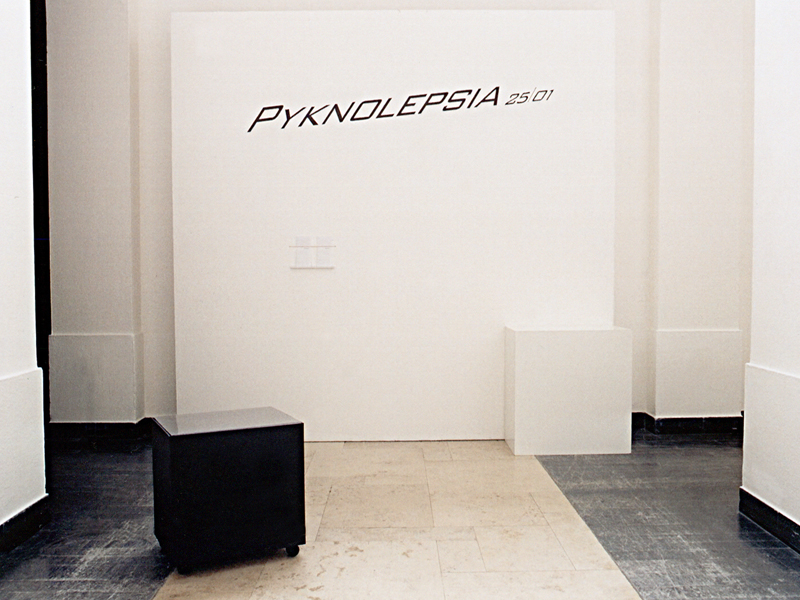
La Epilepsia es una enfermedad crónica caracterizada por trastornos neurológicos y una predisposición en el cerebro para generar convulsiones recurrentes que suelen dar lugar a consecuencias neurobiológicas, cognitivas y psicológicas. Estas convulsiones se caracterizan por una actividad neuronal anormal y excesiva o bien sincrónica que provoca un sobreestímulo y saturación de las neuronas encargadas de decodificar las señales perceptivas y reacciones motoras paralizándolas. Durante un ataque epiléptico las neuronas – cada tipo de epilepsia se concentra en una región distinta del cerebro – se ven bombardeadas por una enorme ‘tormenta eléctrica’ que sumerge al paciente en un estado de inconciencia acompañado de fuertes contracciones musculares. Los hombres de la antigüedad tomaban a la epilepsia por una manifestación divina. Cuanto mayor sea número de estímulos que ingresen a nuestras neuronas menor será el nivel de captación de nuestro entorno. Este número está directamente asociado a la velocidad de captación y decodificación de estímulos tanto perceptivos como motores en nuestro cerebro. Es decir que los límites de la percepción están ajustados a una cantidad armónica de las reacciones químicas que se dan en el cerebro en estado de vigilia normal y que nos permiten apreciar y movernos en el mundo de la forma en que normalmente lo hacemos. De este modo la Epilepsia vendría a ser un estado repentino de saturación físico-mental producido por una especie de sobre-sensibilidad aguda que nos lleva a una ausencia u oscuridad momentánea.
a)
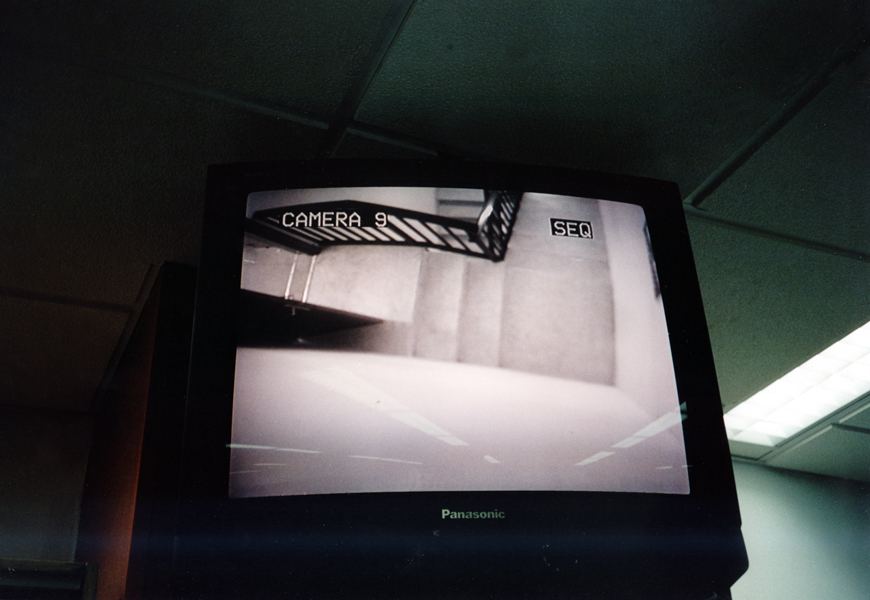
El dromólogo francés Paul Virilio se refiere en su libro Estetique de la disparition (Paris 1980) a esta enfermedad en relación al desarrollo técnico cinematográfico. Dándole a la cámara cinematográfica el lugar de una prótesis que ayuda a cubrir los déficits de nuestra percepción prolongando así las funciones de nuestros órganos visuales. La función que ésta vendría a cumplir sería la de „alargar“ el tiempo de percepción haciendo posible la visualización de fenómenos relacionados con el movimiento. El desarrollo de las prótesis perceptivas se extiende pasando por los sistemas de cámaras de vigilancia hasta llegar a la actual nanoscopía y la fotografía espacial. Desde este punto de partida resulta muy interesante enfocar esta información hacia, lo que podríamos llamar, una ‘utopía de la visión total’. La visión de una humanidad que crea aparatos-prótesis para huir de la oscuridad epiléptica, para alcanzar la visualización completa del universo.
Georg Cantor (1845 – 1918) estableció un número que representa una cantidad sobre-previsible. Este número fue denominado con la primera letra del alfabeto hebreo ℵ (Aleph) y es alcanzado por cualquier número mayor que uno elevado a la n, éste así mismo, es considerado como sinónimo de infinito. Dado que todo número elevado a la ℵ da como resultado un número infinito mayor que el número infinito ℵ y aún ℵ elevado a la ℵ da como resultado ℵ1 – un número infinitamente mayor que el número infinito anterior – es preciso determinar distintas clases de infinitos que a su vez serán también infinitas (ℵ, ℵ1, ℵ2, ℵ3, ℵ4, … ∞). En este fenómeno se basa la paradoja de la Mengenlehre y la teoría de la continuidad. Teoría que aún no a sido comprobada pues tanto su comprobación como su negación son correctas y a la vez falsas. Algunos investigadores comparten la opinión de que precisamente ésta paradoja hizo enfermar psíquicamente a los hombres de ciencia que se ocupaban de resolverla. El caso más famoso fue el del mismo Georg Cantor como así también el de Kurt Gödel.
b)
La teoría de la continuidad establece un sistema de desarrollo ad infinitum que la aparta de la idea de la naturaleza tal y como la vivimos cotidianamente. Es un sistema que responde a sus propias normas. Normas que aparentemente estarían solo al alcance y prefijadas por un ser supremo. El infinito fue en la antigüedad un sinónimo de dios (la escuela pitagórica, la secta de los cabalistas, etc.).
Las nuevas tecnologías nos brindan nuevas perspectivas del infinito relacionadas con la estética del Loop, el Clon y la reversibilidad del tiempo. Estas ofrecen una nueva ilusión basada en la idea matemática de la continuidad que confronta al espectador con un nuevo mundo llamado Virtual en el cual es posible morir infinitas veces y vivir infinitas veces el mismo momento o quizás cada vez un momento diferente.
Jorge Luis Borges (1899 – 1986) describe en su cuento El Aleph una esquina de una escalera en el sótano de una casa antigua en la calle Garay de Buenos Aires en el cual, desde un determinado punto del mismo que obliga al observador a acostarse sobre el piso y mantener una postura inusual, se puede observar un Aleph. Borges lo define como el punto donde se concentran todos los puntos del orbe. En él, Borges ve toda la multiplicidad de elementos que conforman el mundo. Ve cada uno de sus detalles con exagerada nitidez sin que se sobrepongan el uno con el otro y todos al mismo tiempo vistos desde todos los ángulos. La plétora perceptiva, la utópica realización contra-epiléptica.
c)
No creo casual el hecho de que Borges haya elegido una esquina en un espacio arquitectónico para colocar su Aleph. La esquina representa la abstracción matemática del espacio real en el espacio tridimensional euclidiano. El universo descrito por Borges es real, la estructura del espacio en el que se despliega es matemática. La visión es matemática. Tan matemática como los 24 cuadros por segundo del tiempo fílmico y Tan misteriosa e inalcanzable como el cuadro 25 de ese mismo segundo, que se hace ver a sus anchas pero nadie es capas de percibirlo a simple vista.
La plétora perceptiva es la negación de la percepción. Ahí donde nuestros sentidos no llegan se despliega un espacio de proyección mental que respalda la creación de prótesis perceptivas que complementen nuestro ‘equipamiento’ perceptivo. La visión que Borges tuvo del Aleph es el sueño del control total de las clases dirigentes. La victoria sobre la epilepsia.
La pantalla en negro, el sueño en negro, la visión de la oscuridad representarían entonces mucho más que la ausencia de imágenes, la sobre afluencia de información sensitiva.
No estoy muerto. Miro desde arriba este paisaje cinematográfico que fué creado para ser visto y no vuelo. No es un ángel ni un espíritu el que les habla. No es mi pensamiento el que están escuchando. Es una voz que grabé un año después de haber filmado estas imágenes. Aún así; el medio no es el mensaje – lo es quizás para un arte en decadencia, un arte muerto. Pero yo no estoy muerto. Con el tiempo esta aseveración también será una mentira. Pero eso ahora no importa.
Hans J. Williams ha muerto. El nieto del valeroso Charles M. Williams quien cayó luchando para liberar a este país durante las guerras cívicas. Murió pensando en que nadie lo recordaría y tuvo razón. A nadie le interesa el nieto de un simple soldado sin mayores méritos que el haber tenido un abuelo que soportó las atrocidades de la guerra para al fin morir por su patria. En una guerra civil las víctimas de ambos bandos mueren por la patria. Solo las que caen por el bando triunfante son recordadas por ello. Las patrias mueren sin hombres que mueran por ellas. Esa es la paradoja de la civilización: unos mueren para que otros vivan para contar la historia como propia. La historia los amalgama moralmente. Por eso “no existe prueba de civilización alguna que no sea al mismo tiempo una prueba de la barbarie”.1






 Mario Asef