Artist duo – Mario Asef, Kirstin Burckhardt Performance, Video, Sound, Drawings
Being a couple challenges us to expose your vulnerabilities. As the artist duo Asef-Burckhardt, our works (combining video, sound, performance and drawings) ask how large-scale narratives affect the most intimate. We seek a space that is both intellectually sharp and emotionally sensitive. Both of us have studied another discipline next to art (architecture and psychology) and we continue this interdisciplinarity in our joint works. We have collaborated with academics and artists, which demonstrates our understanding of art: not to isolate ourselves as a “duo of lovers”, but to strengthen each other in working for community building and environment. We seek formats in which our artistic works can be experienced in a sensual, multi-perspective way while having a discursive approach. This stems from our conviction that relationships are the place of navigating and negotiating politics and poetics. Together we move in this space between us searching for a sensitive language in the tension of resistance and attraction.
Duo-exhibition by Mario Asef and Kirstin Burckhardt Artist talk moderated by Gabriele Brandstetter Guest artists Dania Burger and Peder K. Bugge
Gabriele Brandstetter is Germany’s first female professor of dance studies. She gained an international reputation as a gender researcher. She successfully developed a new course of study. Dance studies was recognized as a university discipline in 2003 and was integrated into the regular curriculum of the Freie Universität Berlin (FU).
Elena Engelbrechter kam vom Kunstmuseum Wolfburg, um mit uns, dem Kunst–Duo und Paar Asef–Burckhardt, ein Artist Talk zu führen. Die Ausstellung “SHELTER-BONE / Lieben in Krisenzeiten” wurde von Stephan Klee für den Kunstverein Göttingen kuratiert.
“MOTHER-BURN” is the second video of a trilogy by the artist-couple Asef-Burckhardt. It was filmed on-site in the burned remains of a Redwood tree grove in the ecologically avantgarde architecture project “The Sea Ranch” in Northern California. Based on extensive periods of research there, Asef-Burckhardt created videos, drawings, paintings, performance, sound, photographs and poems produced on site and in Berlin. Their multimedia project is continuously expanding and shown in changing settings at exhibition venues in different countries.
Artist Talk and Guided Tour with Mario Asef, Kirstin Burckhardt and Sven Spieker (UC Santa Barbara, California) June 14th at MOS Art Center, June 2025.
Curated by Bartosz Nowak
TEXTE ZUR KUNST
THE MATTER IS THE MESSAGE Sabeth Buchmann on Asef–Burckhardt at MOS Art Center, Gorzów Wielkopolski
If everything had gone according to plan for the Sea Ranch – a famed planned community and interdisciplinary group of creatives conceived of and first established in the early 1960s on the California coast – its decidedly inclusive community spirit would have remained at the project’s center. But as is so often the case in capitalist systems, economic interests got in the way. Focusing on the formative impulses that Anna and Lawrence Halprin contributed to the settlement, the artist duo Mario Asef and Kirstin Burckhardt are currently examining the Sea Ranch’s structural and ideological concepts in a series of exhibitions. Sabeth Buchmann visited the second iteration, in Gorzów Wielkopolski. Here she reviews a mimetic-critical engagement to which Asef and Burckhardt subject the Halprin legacy while they, at the same time, render it relevant again through an astute reversal of perspectives.
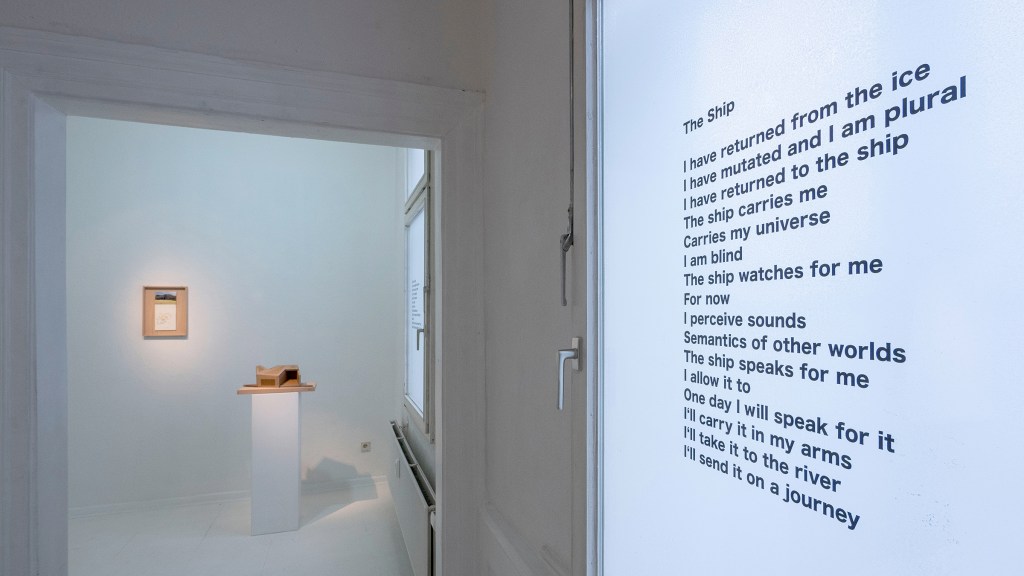
SHELTER – Love in Tough Times is the current project by artist-couple Asef-Burckhardt consisting of multimedia works that will be exhibited at “HAUNT/Frontviews“ (Berlin, G), “Kunstverein Göttingen” (Göttingen, G.), “MOS“ (Gorzow, Pl), and “Wild Palms” (Düsseldorf, G.) in 2024 and ‘25.
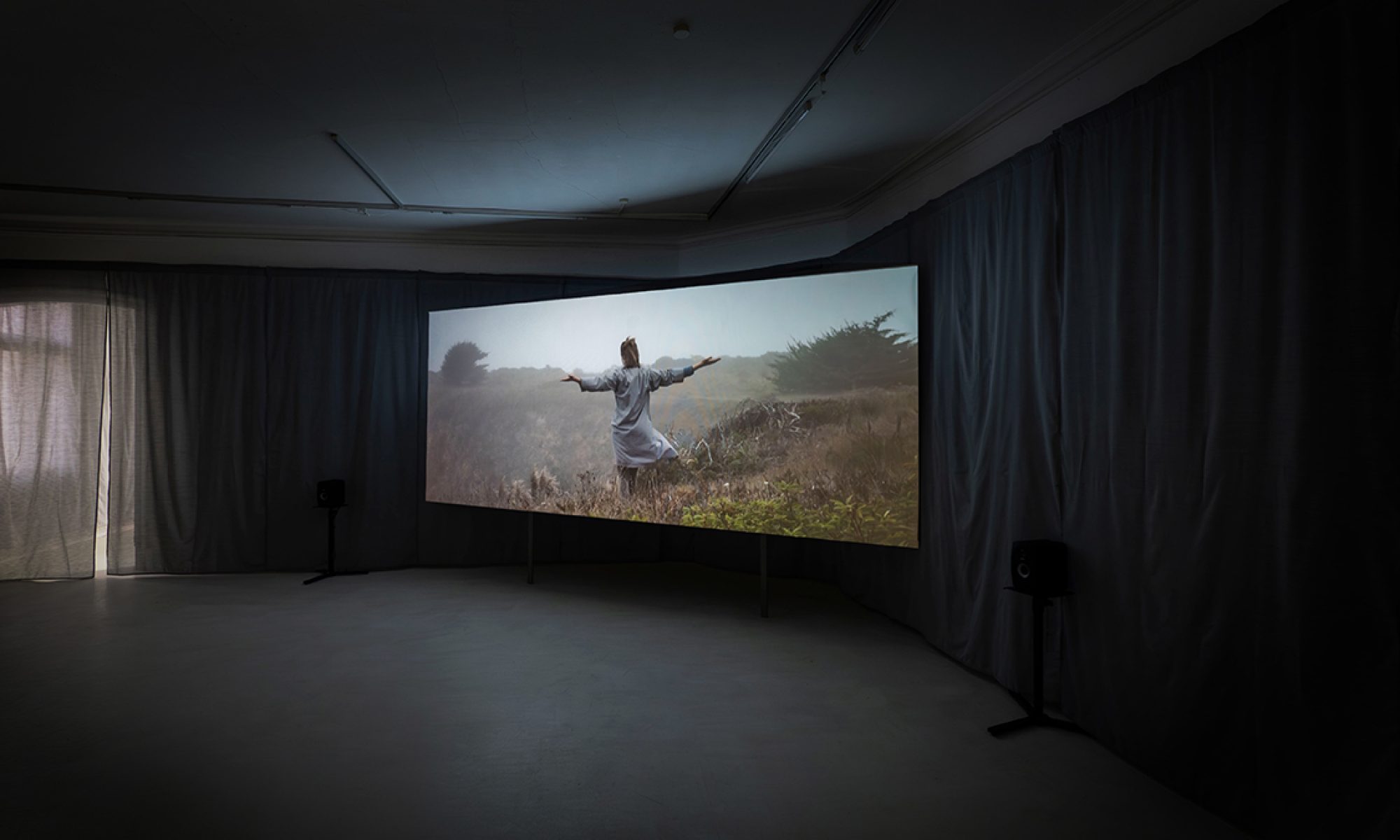
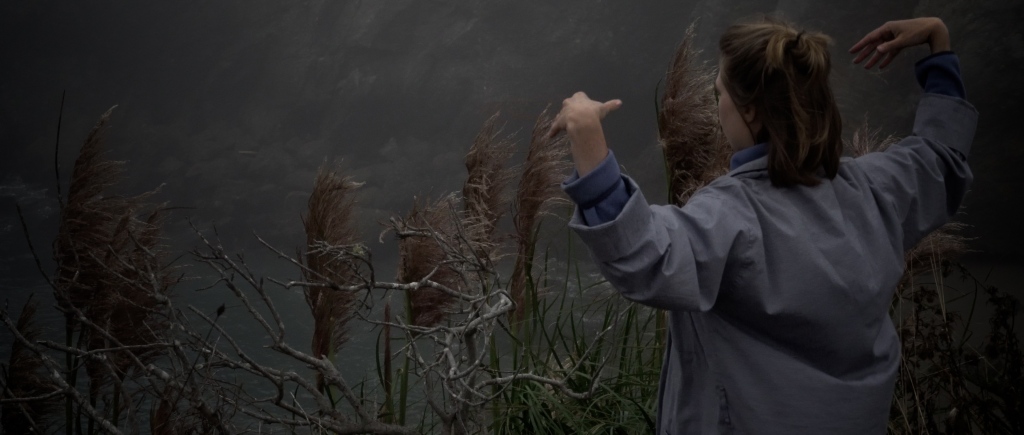
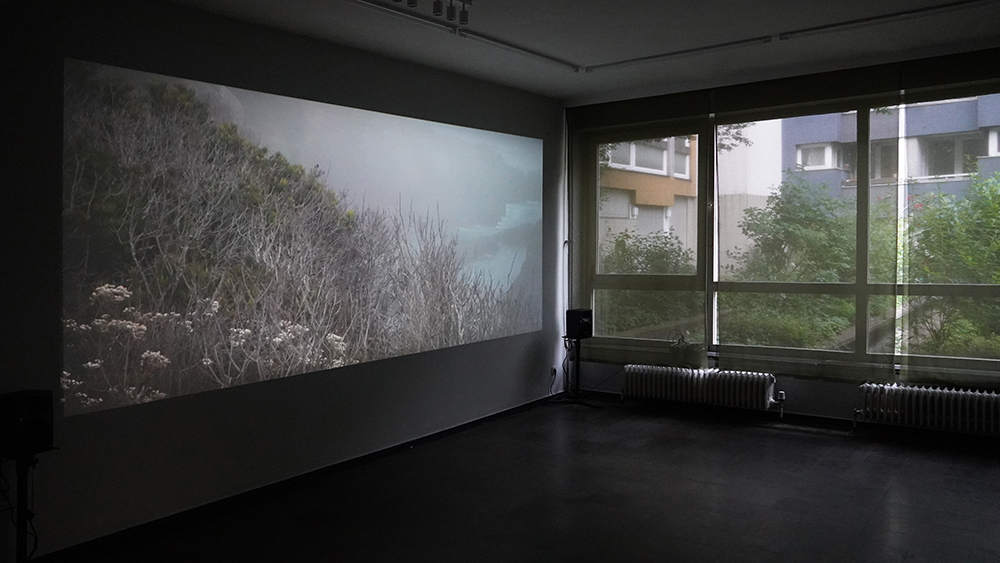
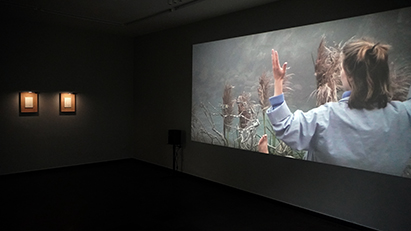
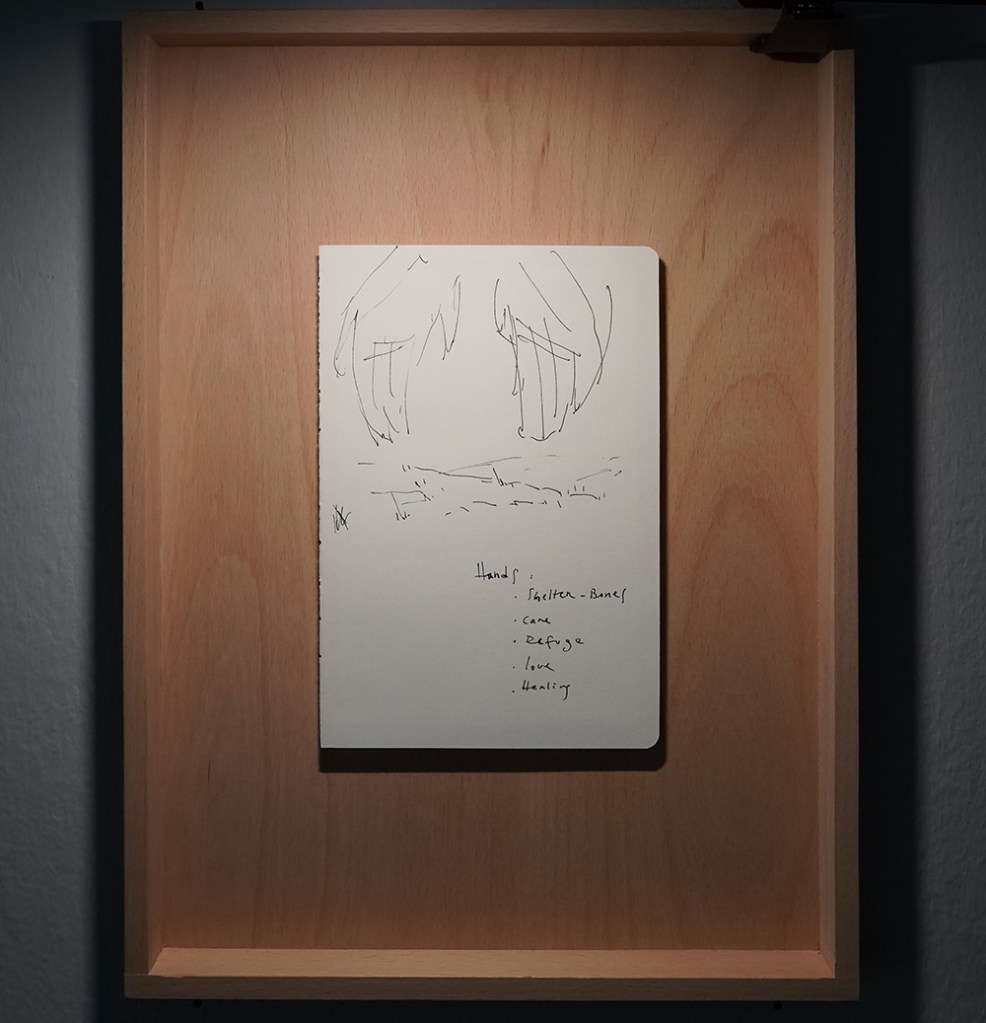
“SHELTER-BONE (To Anna and Lawrence Halprin at The Sea Ranch)”, Asef-Burckhardt, video installation, 4K, stereo, 5 drawings, 28:02 min, 2024
Their works ask: What does “shelter” mean today? Emotional shelters are essential for survival, especially in times of crisis. How do society, nature, the body and emotional health interact with utopia-critical questions against the backdrop of global climate change and its economic and political consequences? This project shows that it is not isolationism but communal refuge that generates resilience, respect and resistance. Shelter and love are therefore among the most important political factors for action in the future.
The works were created during two research trips to the historic site of “The Sea Ranch” in California. Built in the 1960s, The Sea Ranch continues to set international standards for the interplay of architecture and nature – in other words, “shelter“ and “environment“. But what remains of its utopia (“to live lightly on the land“) and the idealism of a sensitive approach to the environment?
Asef-Burckhardt visited The Sea Ranch in 2018 and 2023 and were fascinated by its ambivalence: the clear lines of the houses in soft wooden tones stand at the breathtaking Pacific coast with crashing waves and forests of redwood trees. Yet the beautiful coastal paths are only officially accessible to a privileged audience of homeowners. Many homes are made up of redwoods that have been logged to a minimum. These same houses are threatened by wildfires every year due to climate change. Nearby towns, like “Paradise”, were razed to the ground in 2018. Climate change, privatization and privilege collide with utopia here. These contradictions are exemplary of global crises and will be artistically highlighted in the exhibition.
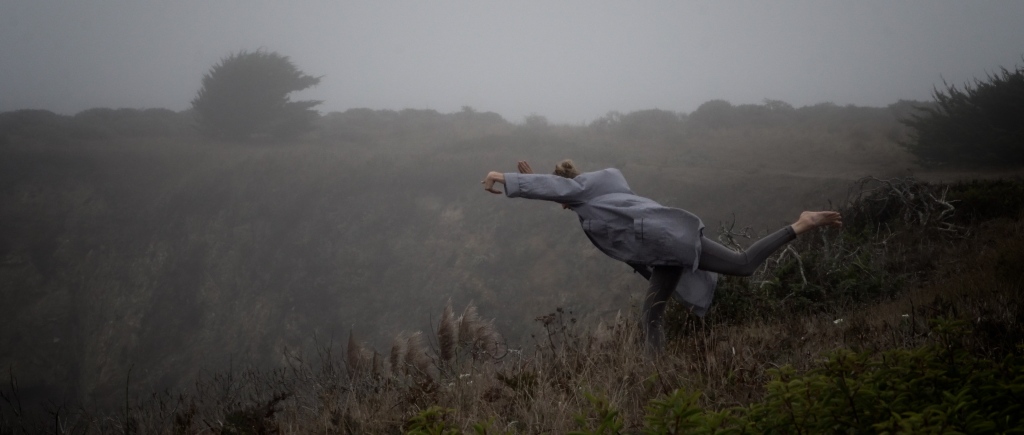
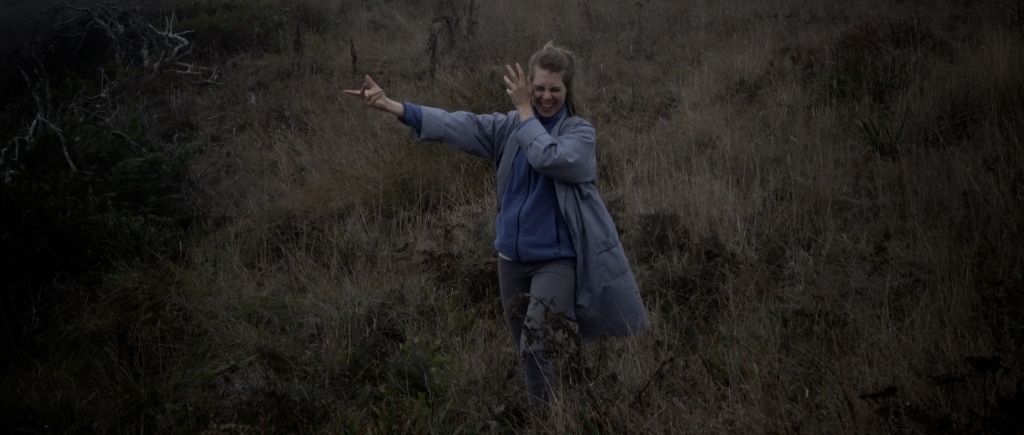
The video “SHELTER-BONE (To Anna and Lawrence Halprin at The Sea Ranch)” is a series of 5 drawings and a 28-minute one-shot video at the rough Pacific coast. It is a dialog of movement between Asef behind the camera and Burckhardt in front, both navigating dense fog and heavy wind, between attraction and resistance. Asef-Burckhardt search for a sensitive language with and within landscape and become part of it: as mimicry with land, wind and plants in constant motion.
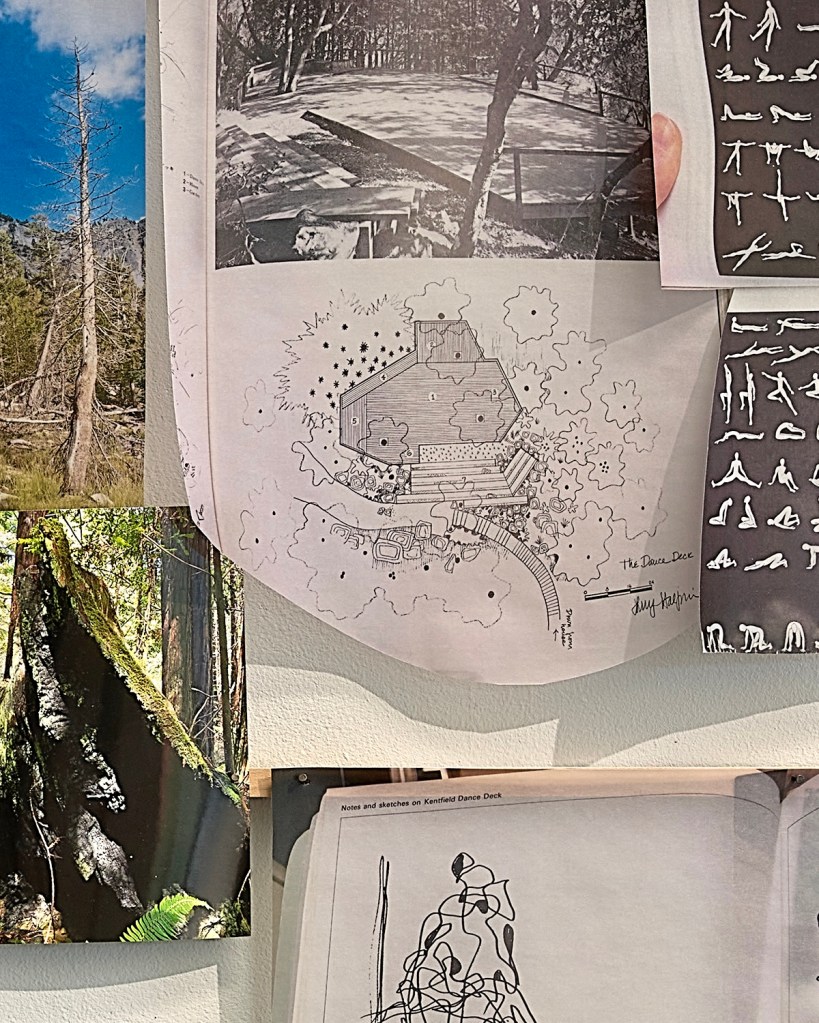
Asef-Burckhardt‘s video work was inspired by the couple Anna and Lawrence Halprin, who worked at The Sea Ranch: He as a landscape architect and she as a dancer with a focus on “embodied healing“. Interestingly, Mario Asef studied architecture before studying art (where he first heard about The Sea Ranch) and Kirstin Burckhardt is both a performer and a psychologist. The artist couple Halprin made a strong commitment to their surroundings through their joint artistic activities. Not to isolate themselves as a „duo of lovers“, but to strengthen each other in order to work together for community building and ecology, is also the inspiration for Asef-Burckhardt‘s present project.
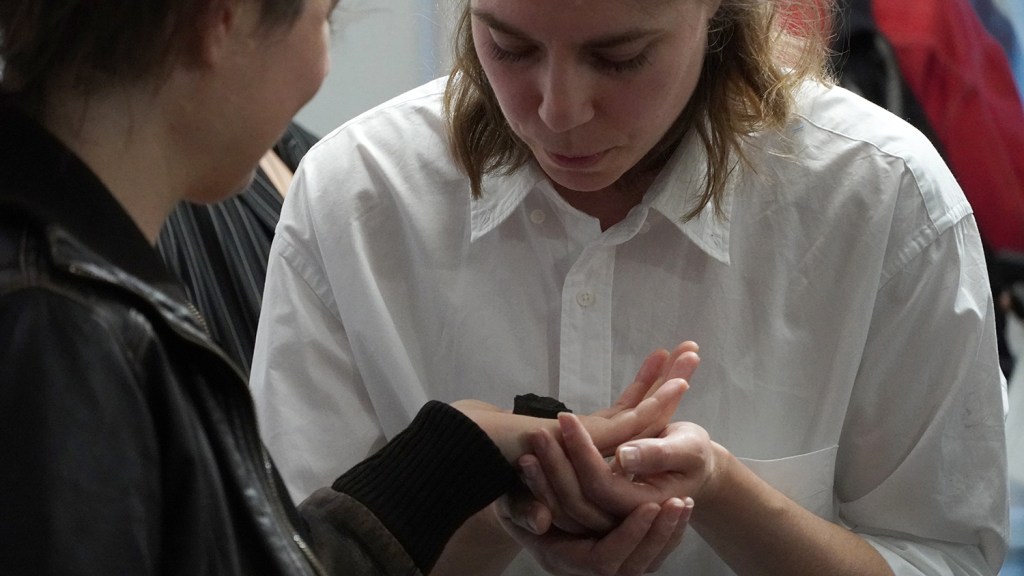
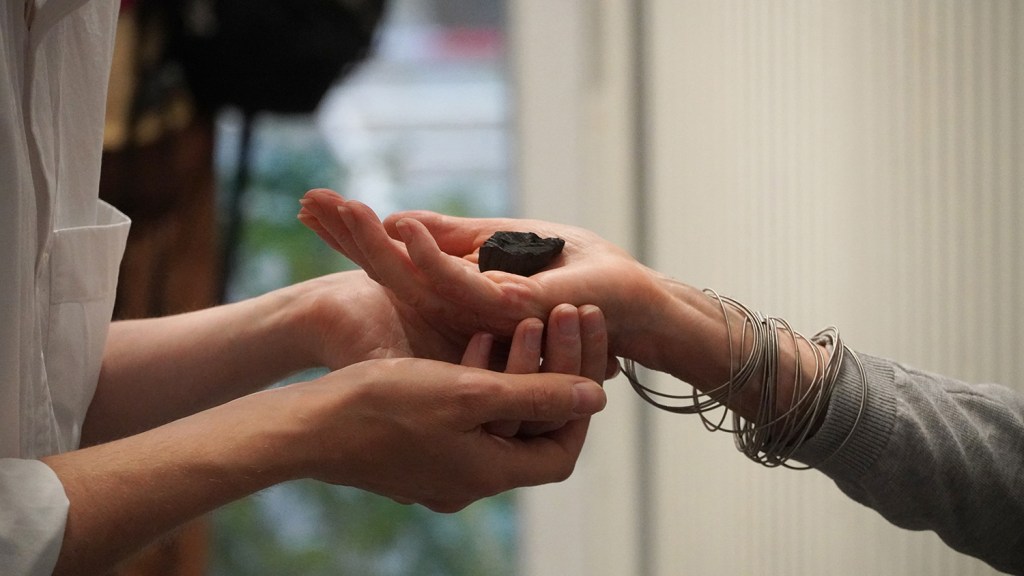
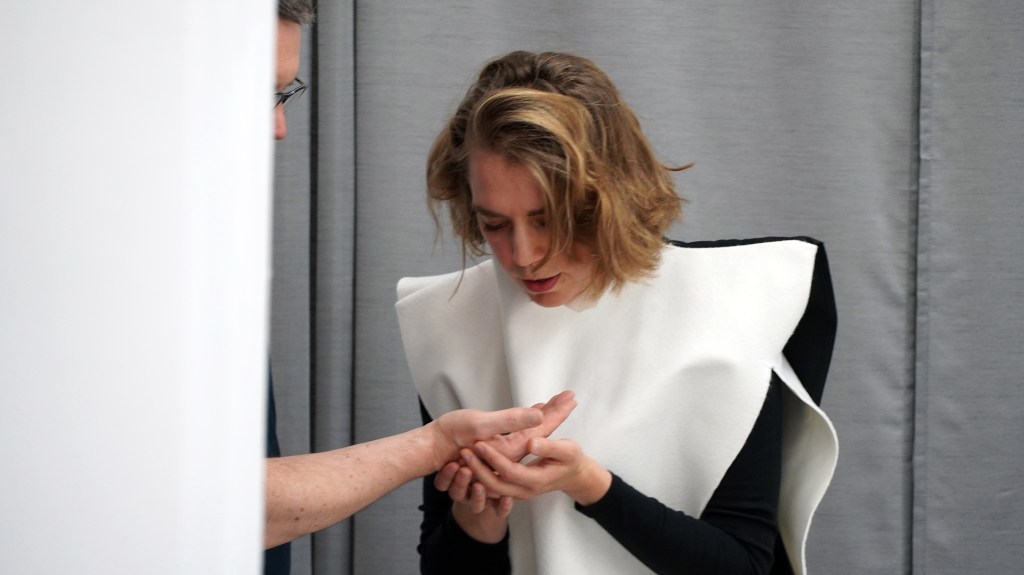
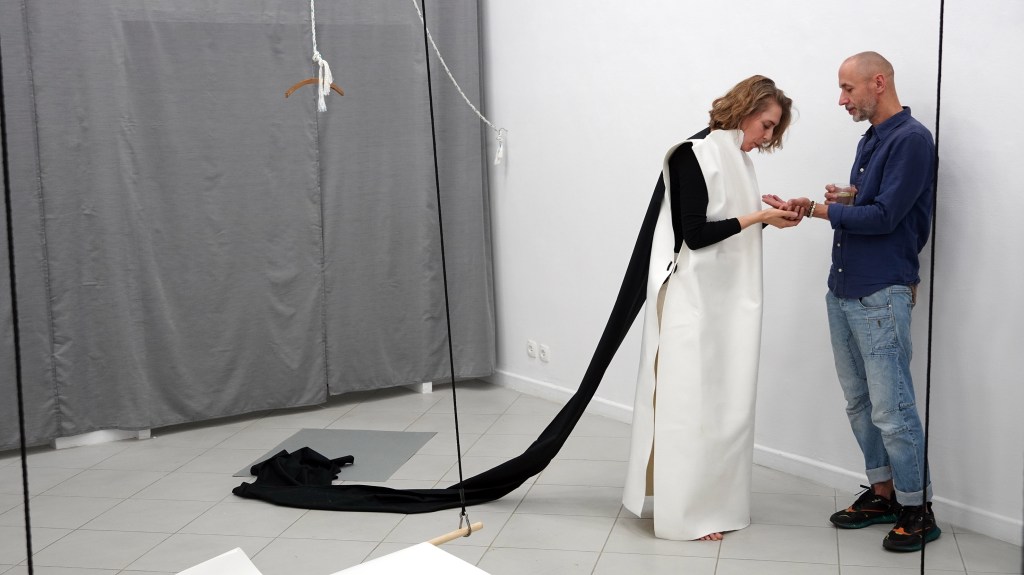
In the video performance “Hand-Charcoal-Song”, Burckhardt sings an impromptu song to and inspired by a piece of burnt wood while standing in the hollowed trunk of a burnt redwood tree – the largest and oldest trees on earth. They have gone nearly extinct due to logging, climate stress, and wildfires. Asef-Burckhardt have collected redwood charcoal pieces from wildfires to extend the video to a performative format, enabling a direct experience between charcoal, voice, and body: During the opening, she and the performer Mathilde Mensink sang into the hands of the visitors gently placing a charred redwood in their hands.
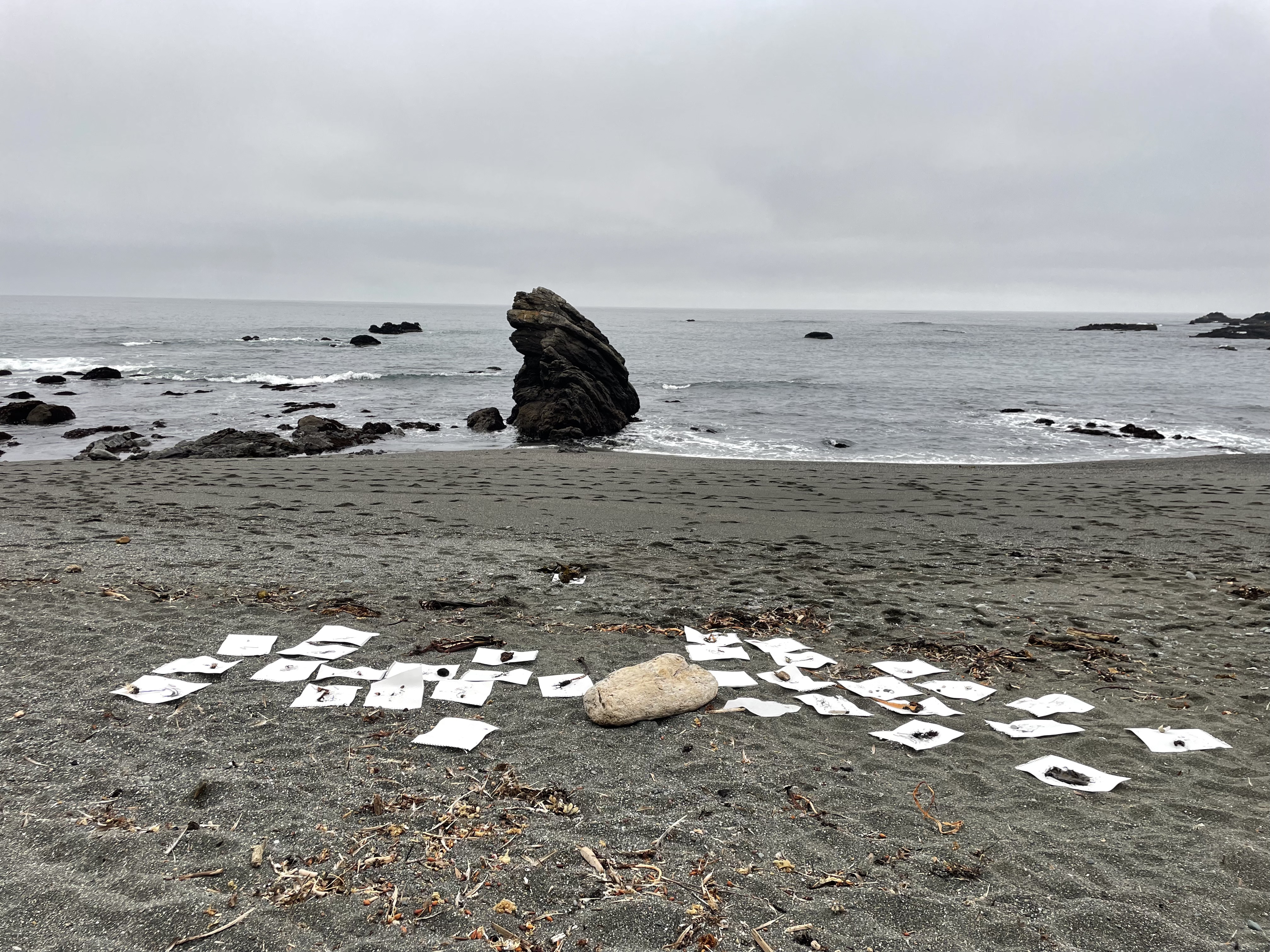
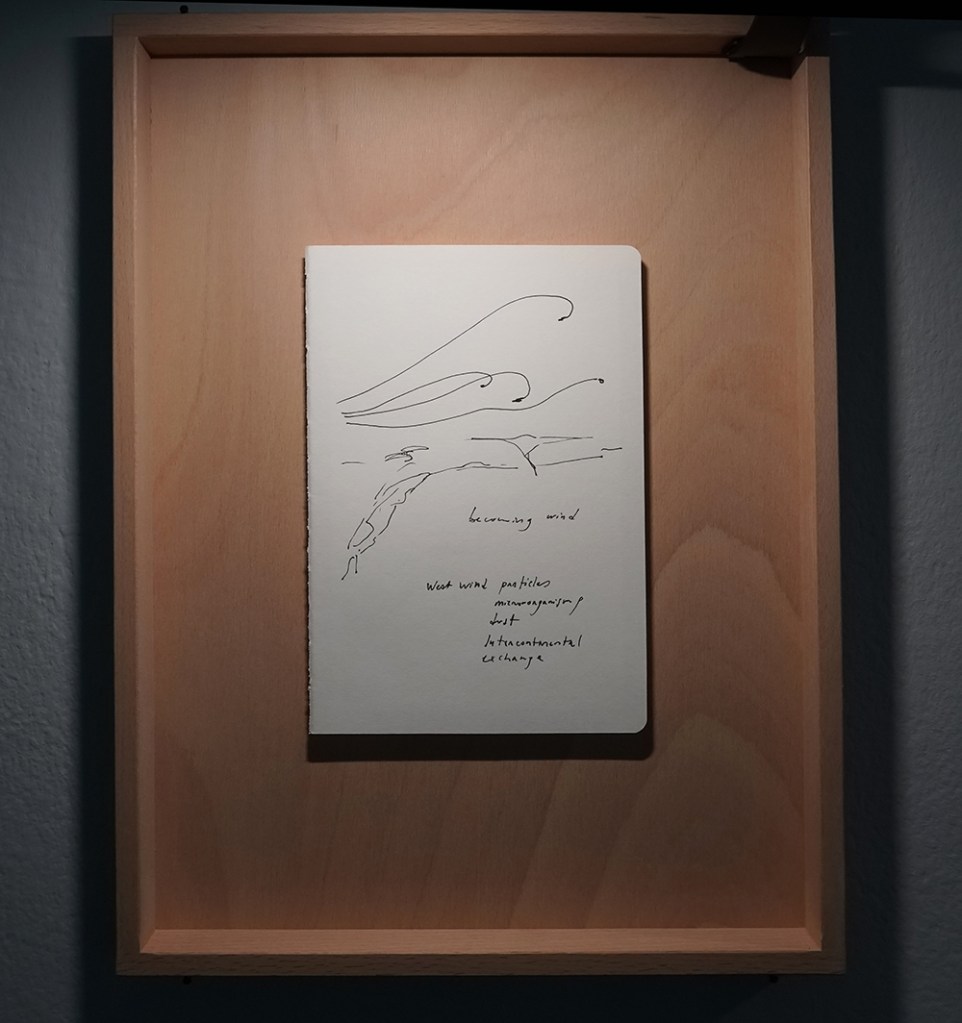
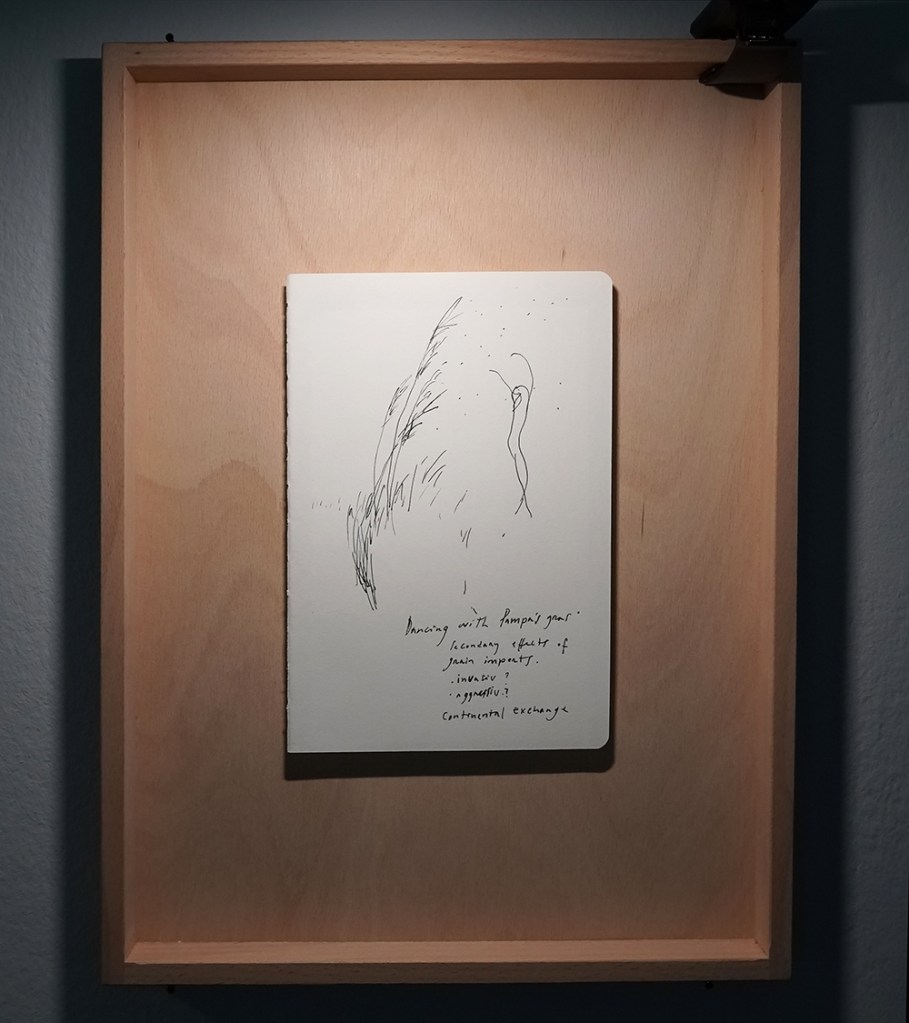
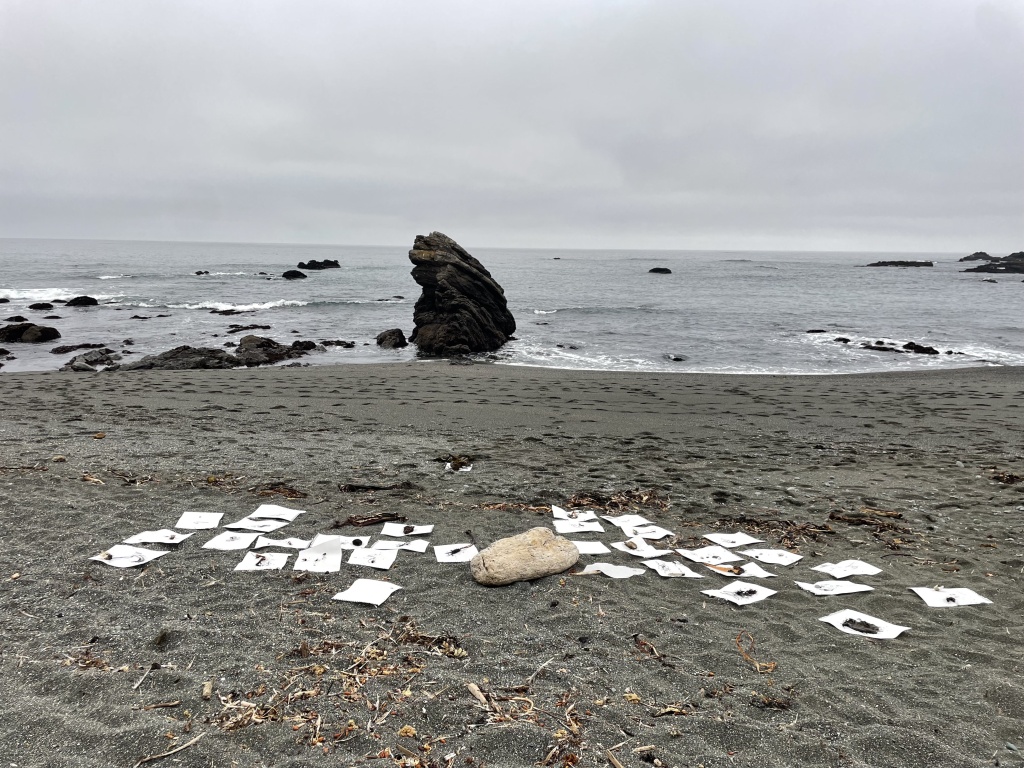
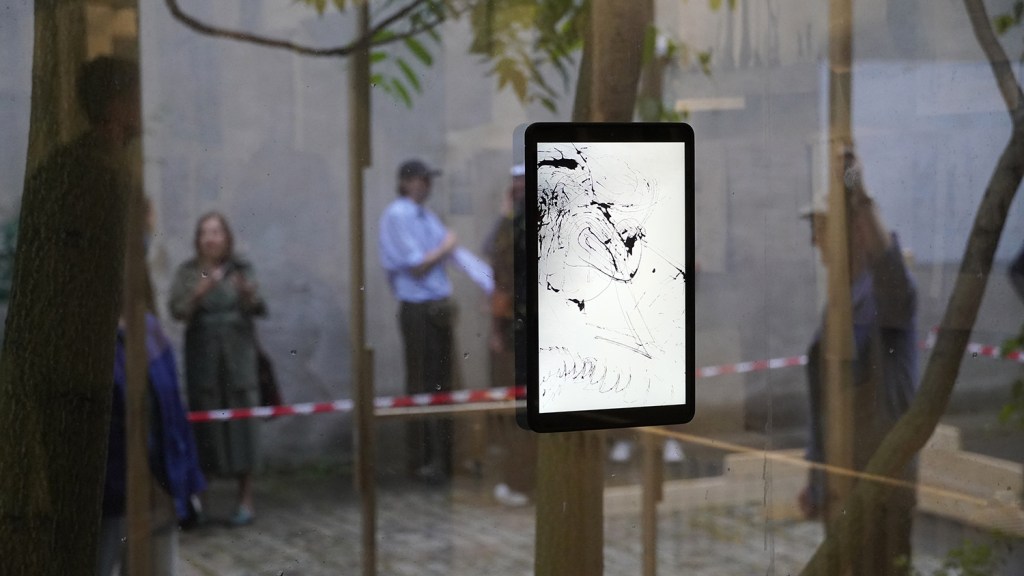
The movement of the ocean washes various organic materials onto the beach at The Sea Ranch. In an archaeologically sensitive manner, Asef-Burckhardt appropriate this material as objet trouvés to record traces with ink on paper on site.
In this series of 25 „drawings“, Asef-Burckhardt seek „handwritten“ encounters with space. But instead of representing landscape by ink, Asef-Burckhardt use ink to fasten the landscape to the paper: The ink becomes the carrier of the landscape itself. Asef-Burck- hardt thereby purposefully push the liminal space between depicting and interacting with environment.
Just as Lawrence Halprin previously approached the Sea Ranch through drawings, Asef-Burckhardt seek a „handwritten“ encounter with the space. The photographs of the drawings in their natural environment are shown as prints.
Sound installation of charcoal from burnt redwood trees
Redwood trees are land dwellers that are among the oldest living beings on this planet. Some trees are 2000 years old. Today, their numbers have been reduced to a few percent by their use as building material, also at The Sea Ranch. Wildfires accelerate the CO2 problem due to the lack of photosynthesis.
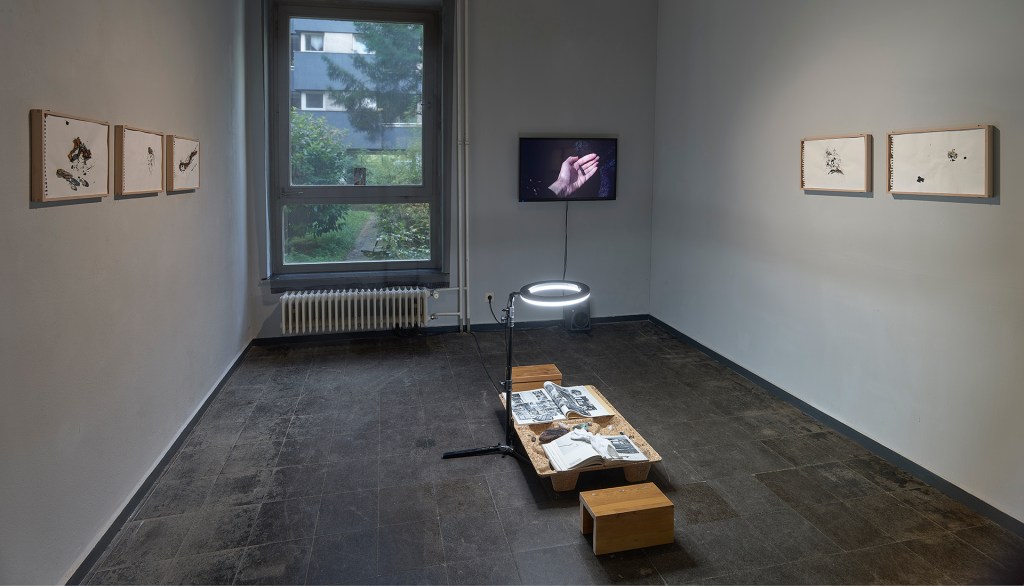
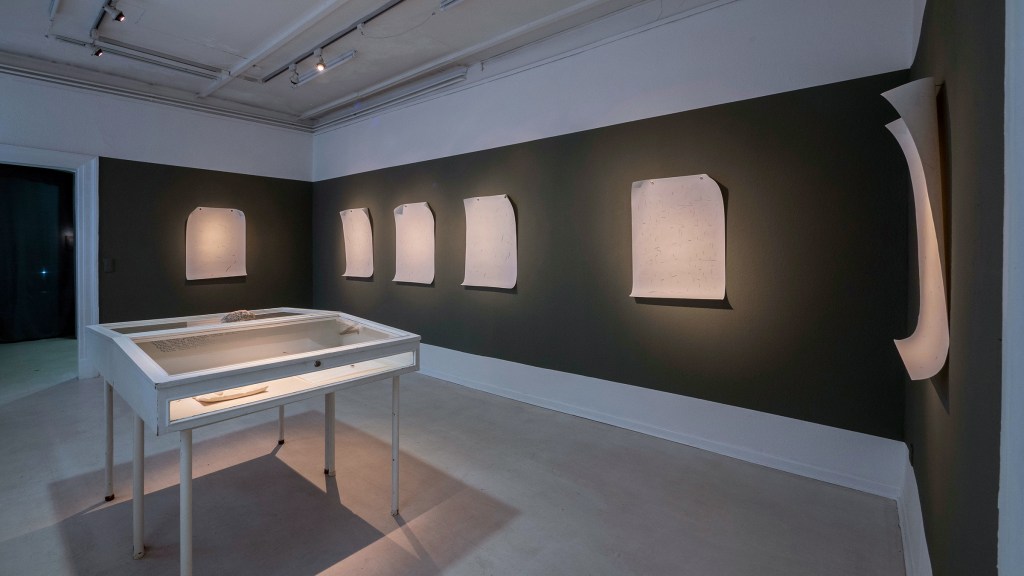
For their sound installation “In Between Before and After”, Asef-Burckhardt collected charred wood from sequoia forest fires. These charcoal pieces are set on a room-sized paper installation. Two transducer loudspeakers, attached to the paper, make the paper vibrate as a sound membrane, thereby causing the charcoal to tremble, creating dust and lines that draw traces of their conversation audible in the room. The spoken word emanating from the loudspeakers combines Asef-Burckhardt’s research and conversations, between dystopic and caring visions, asking: What could you write with a piece of burned Redwood charcoal that is not painful?
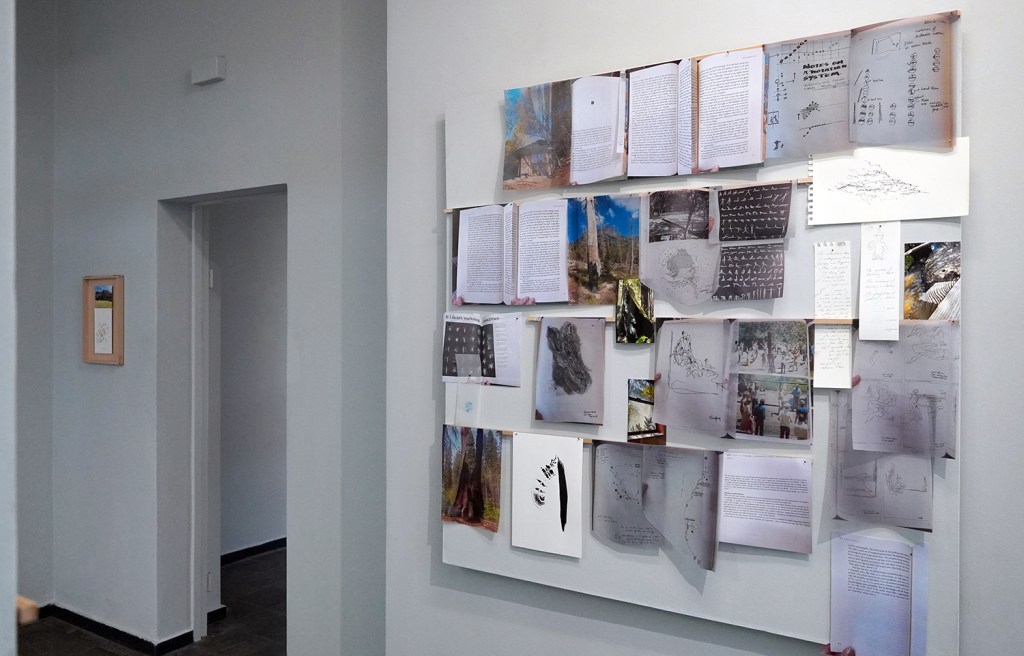
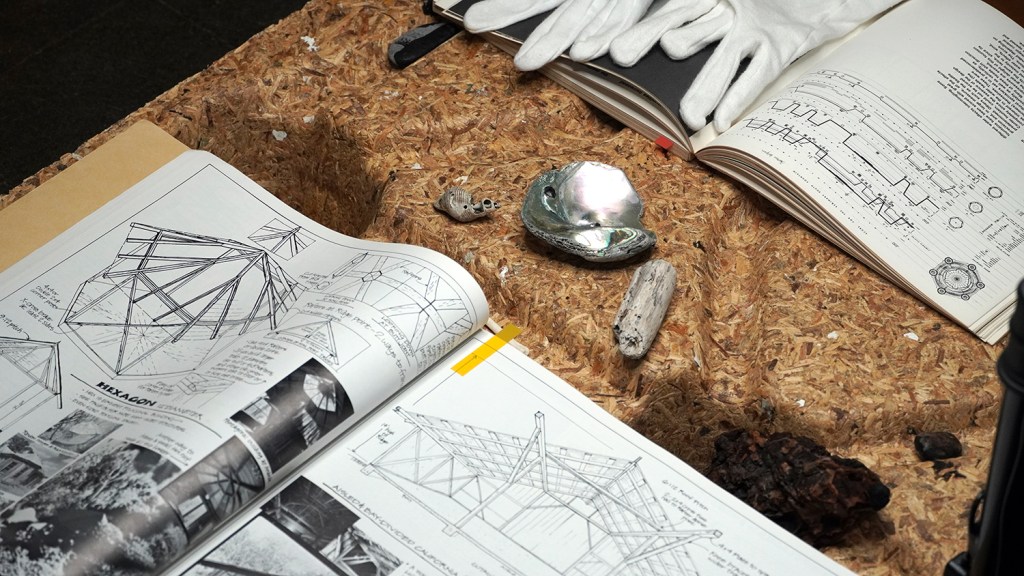
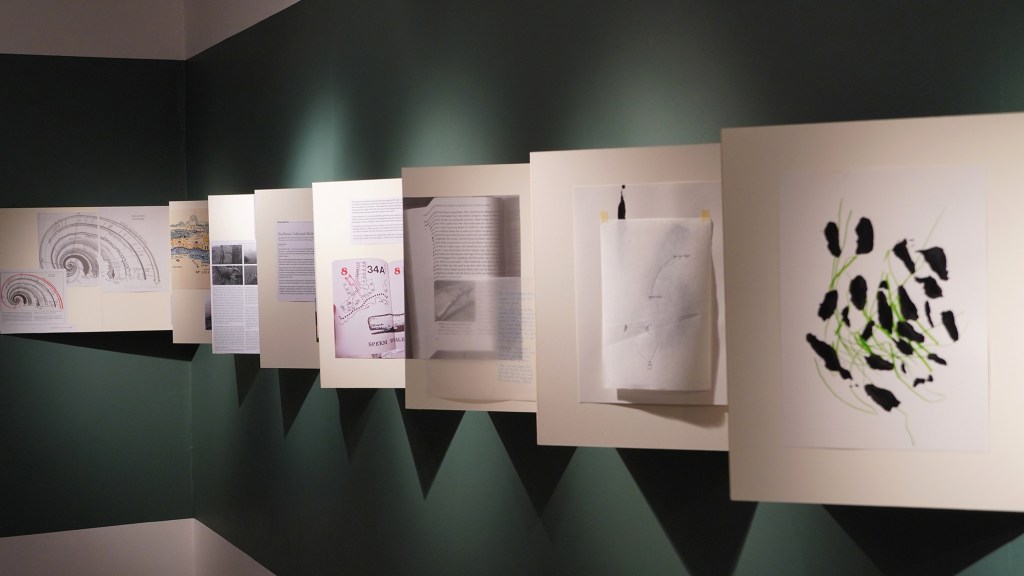
The archive consists of drawings, books, audios, and prints that offer insight into the artists‘ research and personal archives, probing and contextualizing the exhibition like a thread. The works come from two research trips to the historic site of “The Sea Ranch” in California. Built in the 1960s, the Sea Ranch continues to set international standards for the interplay between architecture and environment. This is also where the iconic choreographer Anna Halprin and her husband Lawrence, The Sea Ranch‘s landscape architect, worked together for community building. Yet, today it’s clearer than ever: It is a place where utopia and harsh social and ecological reality collide.
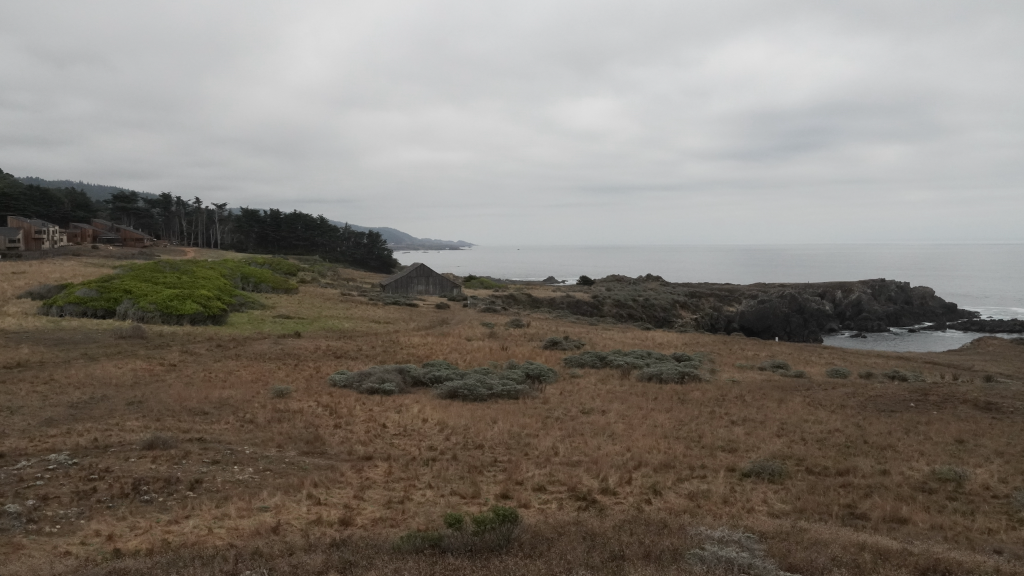
Around the “Old Barn”, which served as the model for the entire architecture of The Sea Ranch, Asef-Burckhardt developed an immersive audio experience that can be experienced on site. The aim is to make the audience aware of the environment from a perspective that is “vitalist” (in the sense of Jane Bennett’s recourse to Spinoza, i.e. that life is in all entities and that they play an active role in the creation of the world) and “materialist” (in the sense of the importance of tangibles).
Sharing dreams and nightmares – could that summarize a love relationship? Being a couple challenges you to expose your vulnerabilities. We have been documenting our talks and images that expose the unfiltered psyches of lovers.
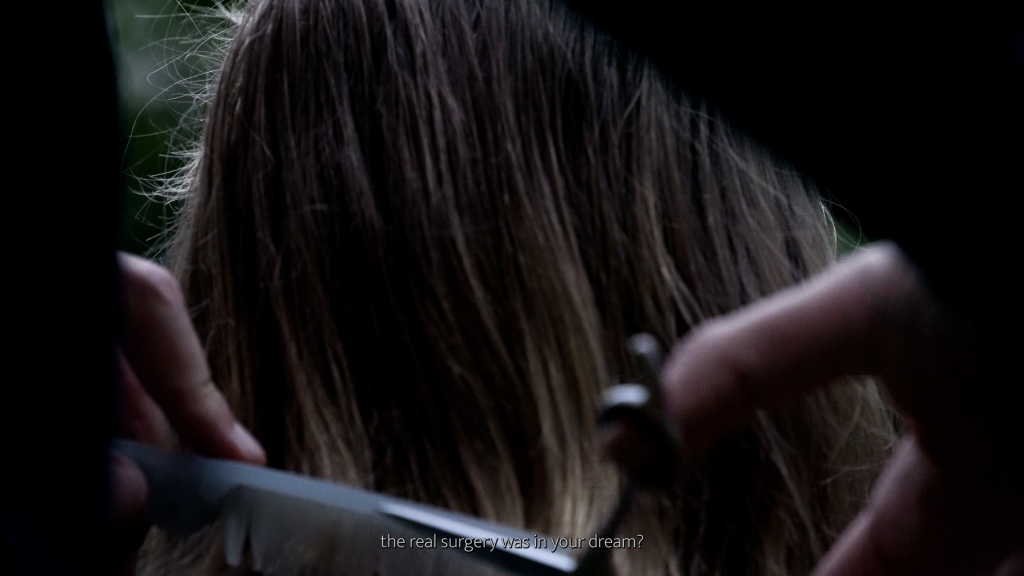
”Conversation 01“ is the first of an ongoing series of video works compiling conversations between us as an artist couple. “Conversation 01” dives into the subconscious of a dream as a departure point for body-rupture and the nuanced task of recomposing the semantics of symbols by deep listening. It explores the question: How do we co-create a space of dreaming?
The second video in our series “Conversation” tells a story of loss and longing. It contemplates why we can or cannot finally let go what we hold dear.
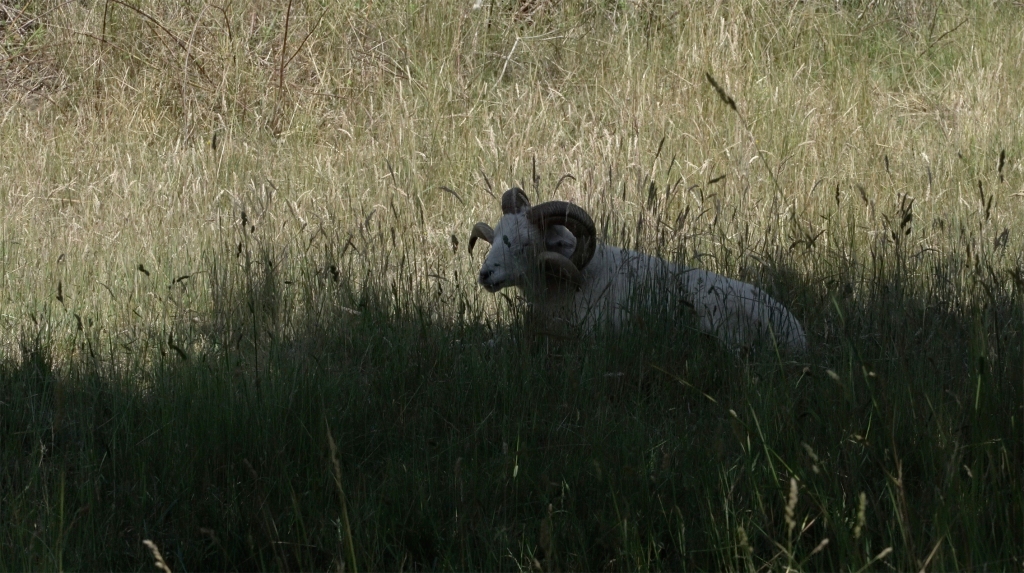
Just like memory maps our identity, it asks how time feels to a ruminating goat. Inspired by Borge’s poem “The Keeper of the Books”, the video takes an unexpected turn as Asef recounts his personal memories of his father and compares him with the poem’s narrator that says:
“In my eyes there are no days. The shelves stand very high, beyond the reach of my years, and leagues of dust and sleep surround the tower. Why go on deluding myself? The truth is that I never learned to read, but it comforts me to think that what’s imaginary and what’s past are the same.”

















 Mario Asef