Language is not a welcoming land, as much as we tend to forget about it in daily communication. Reality is also not a welcoming machinery, though it seems that we have grown used to its rusty hinges. Mario Asef’s work detains both language and reality (the cultural engine that produces it) with a minimal intervention that modifies their landscape. He respects the structural elements of language or cultural situations, he studies them. And then he introduces a slight modification that provokes a twist, a bristle that detains some elements of our cultural structure in an unexpected angle. Finally, he puts them back to roll into the structure, now affected and changed, and, most of all, exposed to our perception. The ground of facts is a spiderweb (Der Boden der Tatsachen ist ein Spinnennetz), we read in one of his statements, which could easily be understood under the logic of the aphorism. Common sense is a fragile territory, and our security cannot be anymore established in the ground of facts. Language also abandons part of its power here, and there is rarely a statement in Mario Asef’s work that is not slightly touched, brought back from its bombastic character into a natural move. This is also a general trait of his work. Again, something is modified, and our perception and thought are affected, but this is done elegantly. A scarce or apparently casual line drawn there where you would not need it or expect it, can be enough sometimes. In Asef’s pieces danger is not in tragic and dramatic exposures. It lies right before us, in a very small margin that has been taken out or changed.
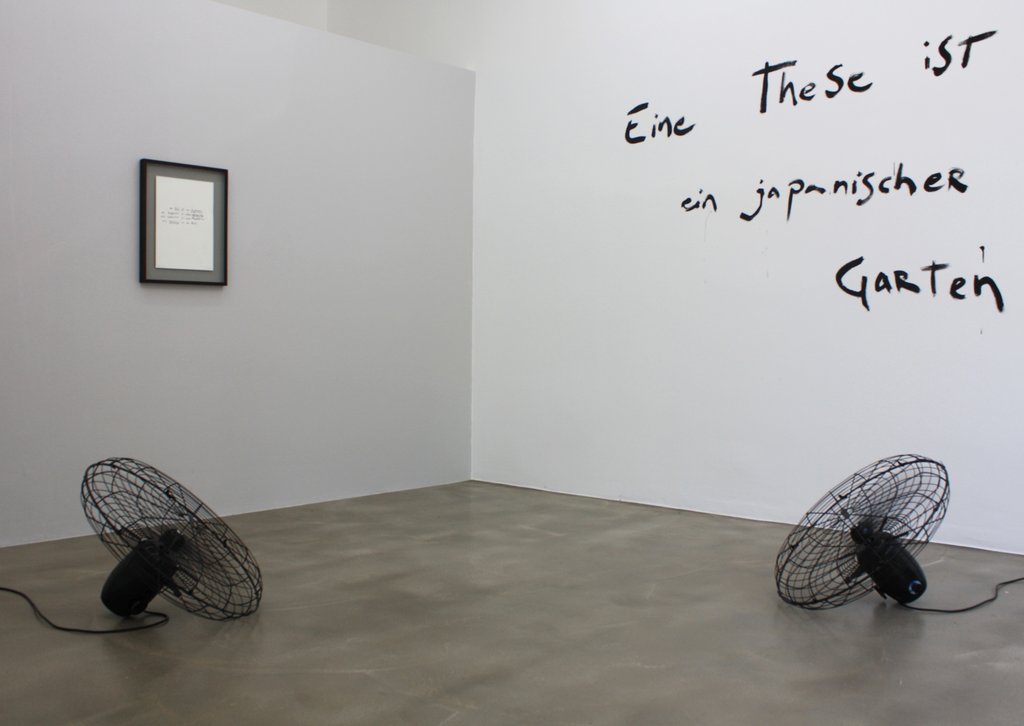
A thesis is a Japanese Garden (Eine These ist ein japanischer Garden) says the writing on the opposite wall. It would actually be a relief to think that we can bring our walk through the garden to a memorable ending, the hill that offers us the harmonious view of our thoughts and actions. And we might need indeed a breath into this fragile (or solid sometimes) phantasy before going down back to the garden. This closeness and return to the material is a recurrent question in Asef’s work. Be it a brick, a cake, debris, a lottery poster or the ink of words on the page, the materiality of thought is always perceived. Thus, there is never a two-dimensional experience, space, even in a small caress of volume is present. And this is especially striking in his statements, where language thinks (as it happens with the aphorism) within a very small margin of space and through very few elements. But the weight of the word on the white page (which could turn this kind of writing into visual poetry or slogans) is too much, it unbalances sensitivity. And there is where the line appears. It is never a decoration, and its relation to the words is not clearly stated. But it seems to have the function of bringing back language a little closer to its materiality, even to remind this inked decisions that there is a void around them. Casual, programatic, or even ironic or playful sometimes, the lines that appear in Asef’s work create a relational tension that incorporates language but also goes beyond it. Those lines need to be handled with care, and cannot always be trusted. So the best thing we can do is to approach the ear, the eye, and ask them what are they thinking in there. For there will be no better clue to understand and enjoy the unbalanced garden they are part of.
Ernesto Estrella Cózar is an educator, poet, and musician born in Granada who has lived in New York between 2000-2012. He completed his Ph.D. at Columbia University, and between 2007 and 2011 he was assistant professor of Contemporary Poetry at Yale University’s Spanish and Portuguese department. Since the spring of 2012 he has turned to Berlin as a second base for his artistic and academic work. As a musician, he concentrates on the voice’s potential to explore the poetic process through sound. In this vein, he has created a wide array of performances that have been presented at international festivals in Argentina, Uruguay, Austria, Germany, Spain, Croatia, Russia, Finland, Latvia and the U.S. Since his arrival to Berlin, he has been teaching seminars at Potsdam University. Moreover, in 2014 he launched The Voice Observatory, along with sound and conceptual artists Mario Asef and Brandon LaBelle. Funded by Berlin’s Senate, this laboratory of investigation offers regular seminars, workshops and performances related to the voice in its acoustic, communicative, performative, and socio-political dimensions. Most recently, his work in cultural management and civic education has led to the creation of the Nomadic School of the Senses.
The arrival of Europeans in the Americas was an event that would irrevocably change the course of history of mankind. By the time the first explorers had landed, an invasion of the continent had already become inevitable. For sixteenth century Europeans, South America became a screen onto which they could project their fantasies of discovering a new Eden. Many of them lost their lives in pursuit of this illusion, while many Native Americans lost theirs in a struggle to defend their way of life. One man’s dream is another man’s nightmare.
–
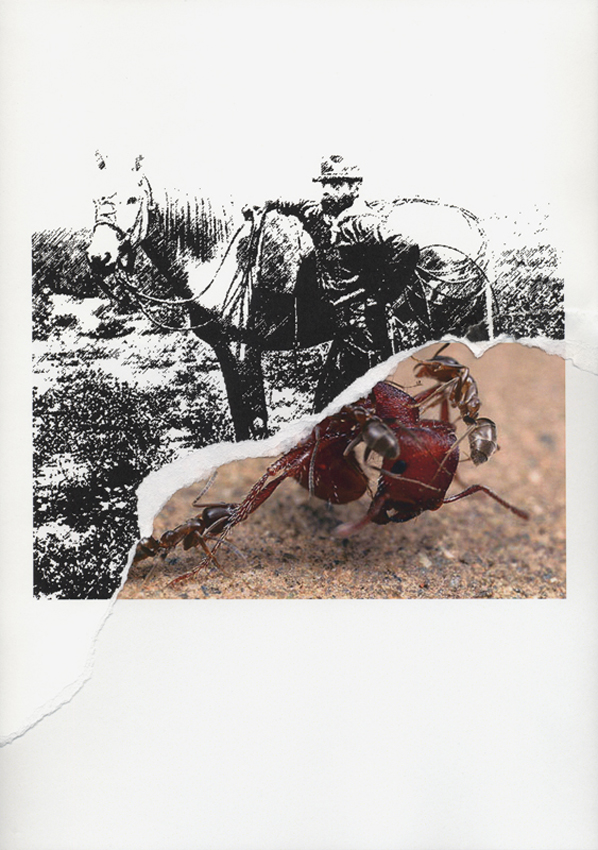
In the early twentieth century, the accidental arrival of a species of ant in Europe drastically modified the coastal environment of the European Mediterranean. Shiploads of Argentinean grain, sugar and wood exported to Europe brought with them the species Linepithema Humile, also known as the Argentine ant. This ant is notorious not only for its exceptional reproductive capacity, but also as an invader that kills and enslaves other native species. From Genoa to the Atlantic coast of Portugal, a stretch of nearly 5,600 kilometres along the Mediterranean coast, there exists a so-called “super-colony” of the Argentine ant.
Since the middle ages Europeans apparently developed a certain “shock and awe” war strategy: an astonishing brutal attack in order to break down the fight spirit of the opponent. The “Hun Speech” of Wilhelm II for example, addressed to the German troops led to the violent suppression of the Boxer rebellion in China in 1900 with the purpose of clearing the way for the German culture once and for all: “No quarter will be given! No prisoners will be taken!“
–
The Argentine ants are very aggressive and due to their quantity take other ant species without difficulty, even ants that are much larger. Argentine ants are unremorseful and brutally attack their adversaries until the enemy colony is destroyed. Even a nest of killer bees would probably not be able to counter against an invasion of Argentine ants. They also attack bird nests, driving off the mother bird and killing the young.
In the early phase of the invasion of South America the Europeans were friendly and cooperative to each other. But as soon as the continent was under control, the different European nationalities started to fight each other. Since the nineteenth century national associations of immigrants in Argentina strained to soften the process of adjustment. Different European communities such as the Basques, Catalans, Italians and French united in mutual aid societies and groups. The new ideas that came with the migrants from Europe led to the rise of the labour movement and allowed for the emergence of anarchism, socialism and syndicalism.
–
While Argentine ants from rival nests normally fight each other to death in their original habitat, Argentine ants from the super colony in Europe have the ability to recognize each other and to cooperate even if they come from nests at opposite ends of the colony’s range.
The Linepithema Humile is a polygynous and polydomous species which means that one colony can have more than one queen and several habitats. And so, when workers from different colonies meet they do not treat each other as rivals which provides the Argentine ants an evolutionary advantage over other ant species.
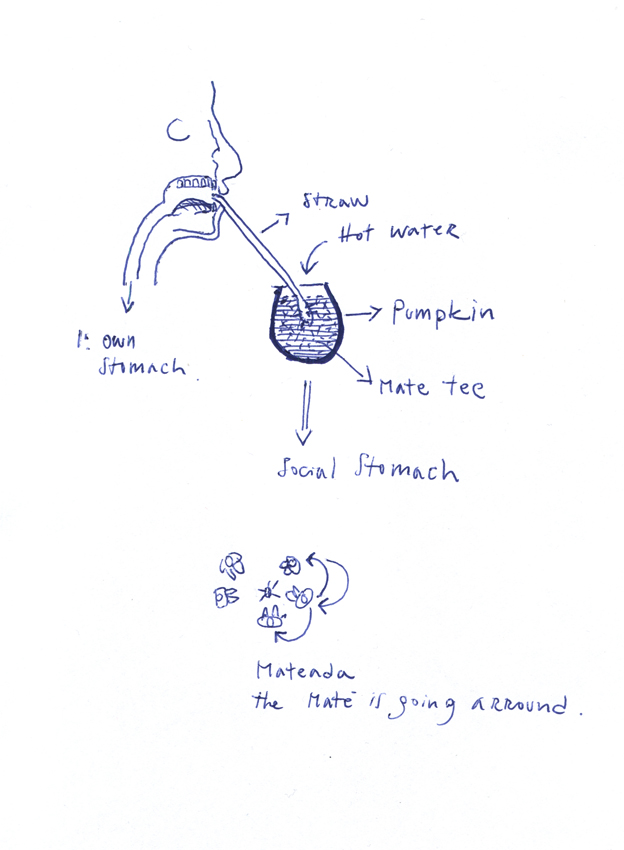
This drink is made from infused dried leaves of yerba mate (holly Ilex paraguariensis). The term “mate” originally referred to the drinking bowl (from the Quechuan term mati, bottle gourd), but is today used for the drink itself. Drinking mate is traditionally a social event around La Plata River. It is served with a metal straw (bombilla). When mate is drunk in a group, the same bombilla is travelling from mouth to mouth. Mate is offered to every visitor, traveller or friend as a welcoming gesture. Drinking mate is a communicative practice which offers an exchange of information among the participants.
–
(Crop)
An Argentine ant has more than one stomach. One stomach is for itself, while the other is the crop that is used to feed others. With their mouths pressed together the ants feed each other. The food comes out of one ant‘s crop and into the other ant‘s mouth. Pheromones come with the food and are exchanged as well. They keep information on needs, excitement or danger. Pheromones can also create a bond or friendship between colony members, helping them to work together.
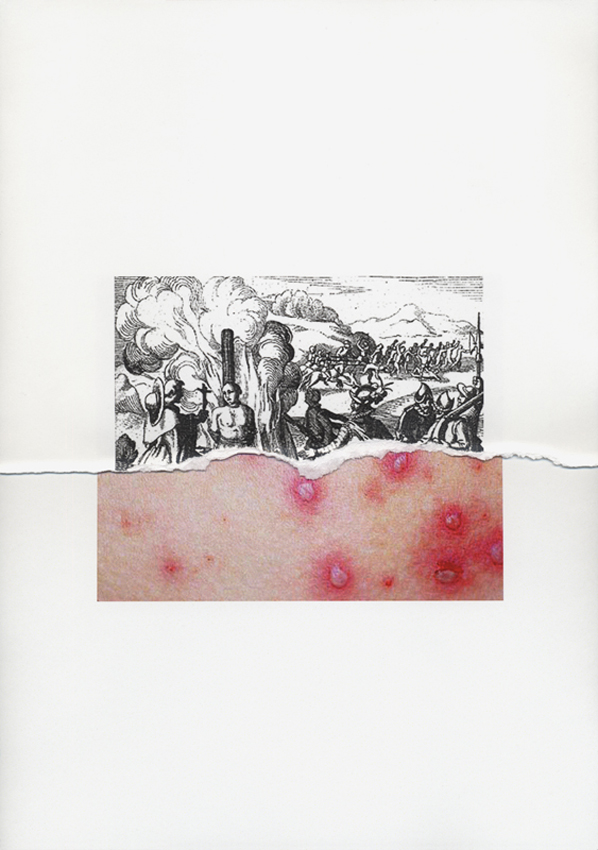
The death of millions of indigenous people during the years of the colonization of South America and further periods of European invasion was not caused alone by physical violence. The massive death rate, which decreased the indigenous population by 90 percent, was also due to diseases like influenza and chicken pox, which came with the invaders. In addition to this, slavery was another important aspect of the high native death rate, where indigenous people died because of bad nutrition and hard labour.
–
The Argentine ants have made a severe impact on Europe’s ecosystems. They have conquered and monopolized the land of South European ant species because of their social rules: The Argentine ants drive out or kill the native ants of a newly invaded territory and steal seeds from their beds. As noted by Laurent Keller of the University of Lausanne, Switzerland: “Cooperation allows the colonies to develop a much higher density than that which would normally occur, eliminating some 90 percent of other types of ants that live near them”.
Human migration is often caused by extreme conditions. Migration is used as a strategy to survive or to obtain a better quality of life. This is the reason why people from areas with lower resources and higher competition emigrate to areas with higher level of resources. The majority of immigrants in Argentina came from Europe, mostly from Spain and Italy but with a substantial influx of British and Germans. Also notable are Jewish immigrants escaping persecution. The total population of Argentina rose from 4 million in 1895 to 7.9 million in 1914, and to 15.8 million in 1947.
–
The extreme domination of certain species within an ecosystem shows clear evidence of a system out of balance. The Argentine ant marked the ecosystem of the European Mediterranean coast to such a degree that the notion of that Area without Argentine ants influence will be inconceivable in the future. It is men who probably created the ant mega-colony by transporting the insects around the world and by continually introducing ants from three continents to each other, ensuring that the mega-colony continues to grow.
Urban space and its appropriation by the people who use it is the source of Mario Asef’s artistic work. In his videos, photographs, sound installations, and interventions the artist deals with architectonic as well as socio-political discourse and investigates how they are represented spatially. Like a researcher he examines the constructions of public life by working against the dominant order in subtle ways. This occurs by reordering things without notice or by removing elements specific to the location and adapting them to the art context. Accordingly, these urban objects are first apprehended as artworks when they are documented in photographs or written about in texts.
Asef’s group of works Empirien (1998-2006) presents an entire series of interventions documented in this way. For instance, in the work Fragile—handle with care/appropriation (2004), the artist placed cardboard boxes in front of the Covent Garden Theater Museum in London, which were then taken over by individuals and used as sleeping spots. By converting packaging into housing, Asef indirectly draws attention to the negative spaces of the city, which make life (survival) possible, but also to the present absence of the homeless. Like illegal immigrants or street musicians, the homeless also count among the—for the most part—undesirable users of public space.1 The artist stages this situation like an experiment. That vagrants then make use of it in practical ways undermines the efforts of local authorities.
In and of themselves the unforeseen and the ephemeral are inherent to Mario Asef’s interventions. He never knows how long his rearrangements will last or whether or how passersby will take them over and put them to use. This participation is the trigger for a non-verbal communication outside of cultural institutions. For the most part the users of the locations involved quickly grasp the initiative, deconstruct the intervention, and reestablish the usual “normal order” of things.
Raumprothesen (spatial prosthetics) can be viewed in many respects as a further development of this creative process. In this case, urban phenomena are actually translocated into the art establishment. Here Asef manifests his socio-critical stance by inviting street musicians to play at his opening. The performative evening was consciously designed to provoke interaction between the art-going public and individuals who operate primarily within the urban locations outside of cultural institutions.
In contrast to Empirien, the participation of everyone involved takes place within the exhibition space. As a result of this appropriation beer bottles, cigarette butts, and trash pile up on the floor and imprints from fingers and people sitting are pressed into the sculptural elements—the “Raumprothesen”—that the artist has integrated into the exhibition. “Prothese” (prosthetics) means here, so to speak, the artificial extension of the room that fulfills a specific function. As such the objects don’t even stand out at first. Rather, their white color and inconspicuous positioning on the margins allows them to be seen as a fixed component of the exhibition space.
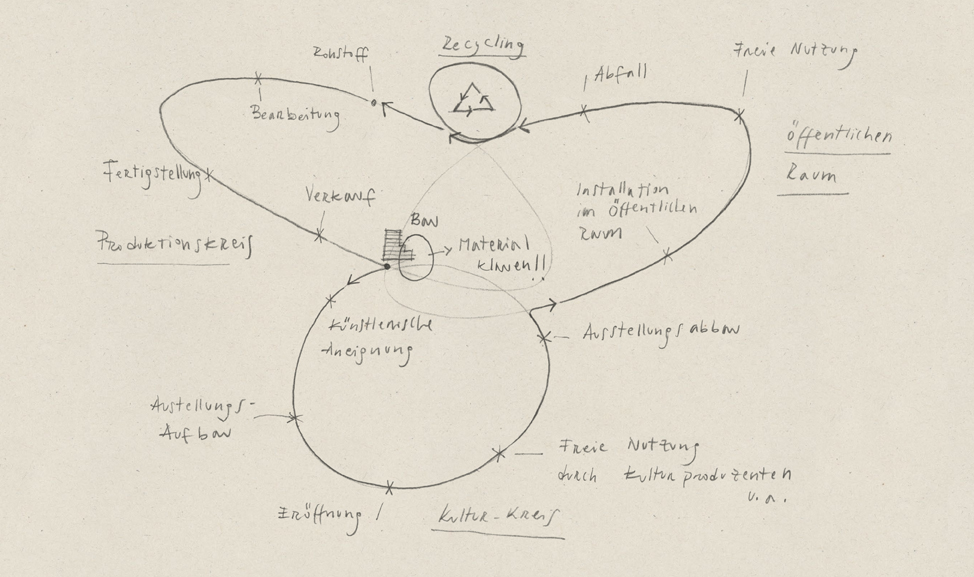
A central aspect of this work involves returning the purported sculptures to the public locations where the elements that inspired them formally are found. For his work Asef initially pilfers material from the city. In this case polystyrene insulation board for acoustically isolating homes is used. In the context of his exhibition this building material is transformed into sculptures. Through their use (disintegration), mostly by the musicians to whom the sculptural elements were assigned as stages, they are, in turn, viewed as everyday objects. Throughout the entire duration of the show the viewer can observe the process of using the space along with its Prothesen. In addition the brief musical performances have been captured in a documentary video as staged memory, and are continuously on view. Here the quality of the recording plays a secondary role. Asef films more like an anthropologist who attempts to understand the circumstances from a distance. After the presentation in the art context is over, the objects and musicians alike make their way back onto the streets. Once there, people will again use the “Raumprothesen” as seating and eventually dispose of them. With this, a cycle of varying translocations and ascribing of meanings apparently comes to its end.
Whether in urban public space or within the space of an exhibition, the experience of those involved in Mario Asef’s interventions go far beyond the actual participation. Rather, through his subtle interventions, the viewer is sensitized to the processes at work in urban, social surroundings.
1 Asef’s socio-critical stance goes back to the artist’s own personal experiences. He himself migrated from Argentina to Germany twelve years ago.
—
The Author
Susanne Trasberger (formerly Köhler) studied cultural sciences and aesthetics at the University of Hildesheim. She curated several exhibitions in Berlin (e.g. NGBK), Worpswede and at the Kunstmuseum Wolfsburg. She was director of Kunstverein Junge Kunst, Wolfsburg, production manager for the exhibition XIII. Rohkunstbau in Berlin and published various art catalogues. She currently lives in Berlin and works for Texte zur Kunst.
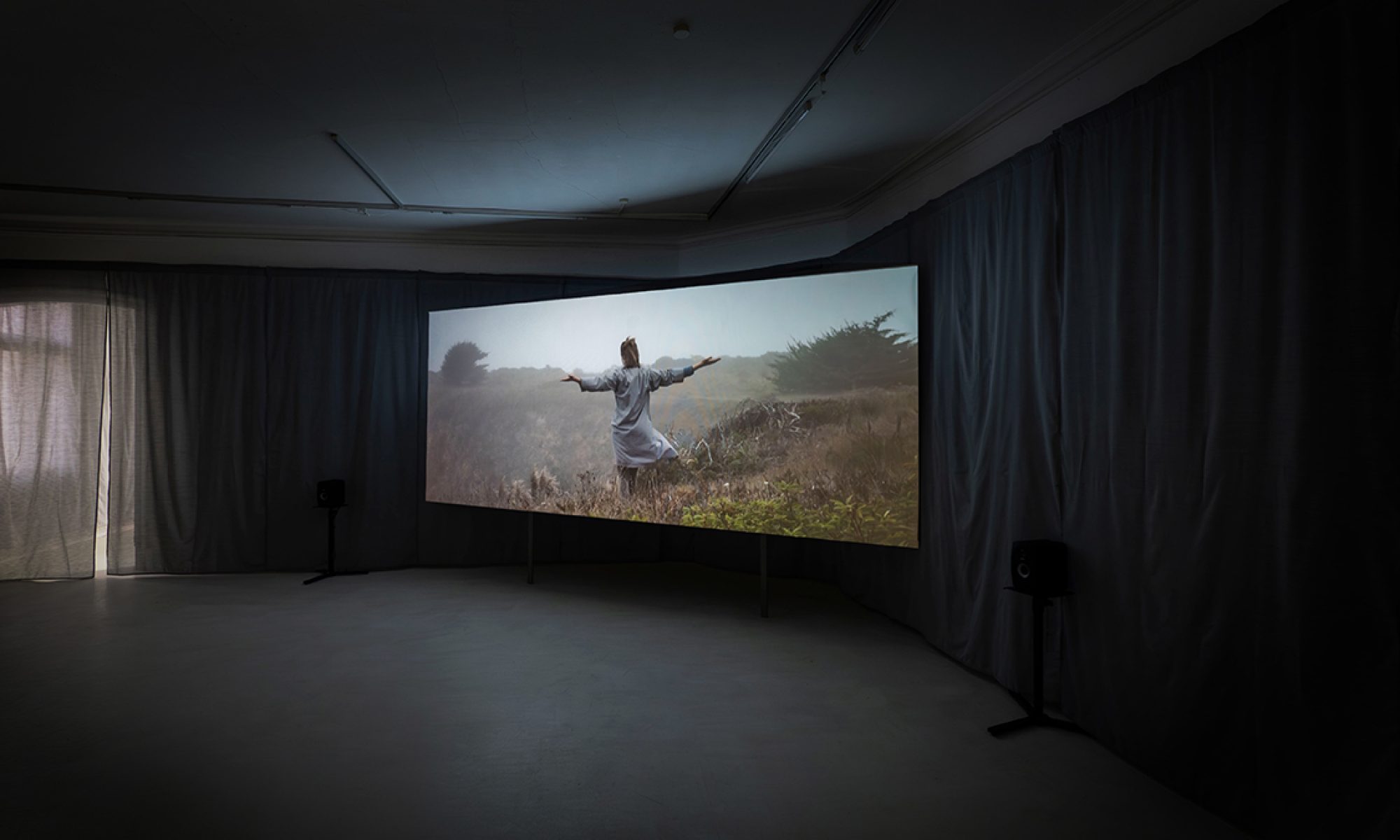
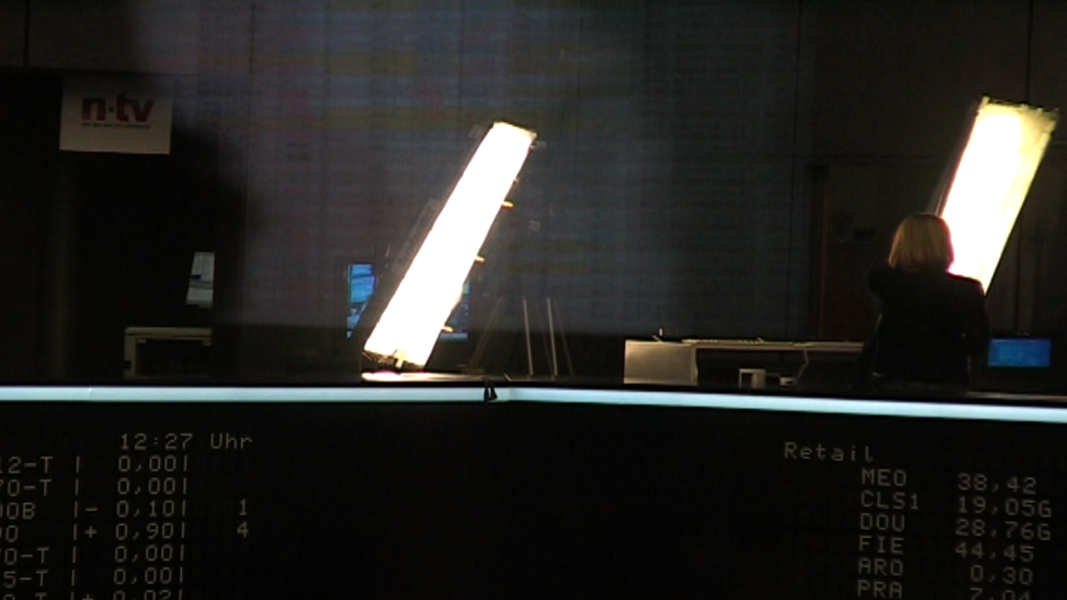
Mario Asef’s camera simply observes—it does not monitor (by recording everything in a blanket manner), it does not stare (by focusing unscrupulously), it does not gather (by picking up everything that passes before its lens), but it is just there, it observes what is happening, very directly, in the margins of goings-on and locations. It seems completely natural when a plastic bag catches its attention, following it as the wind buffets it about on a square in Buenos Aires (Edad de hielo / Ice Age, 2011). Or when it beholds a preacher for world peace at an intersection in London (Pass Over, 2003-5). Or it sits as a silent guest behind the visitor’s window at the Frankfurt Stock Exchange, registering the activities on the dreary floor in front of it and what is happening on the other side of the door outside (Börsianer / The Operators, 2009): the operators are working in the cut-throat field of global speculative trading as if in a semi-public cage, whereas those stranded on the streets are left to face its consequences with their own bodies. Images of artificial nature mediate between the agonal spheres.
The attentive gaze of Mario Asef’s camera quietly watches the everyday details of the world, thereby making it possible to draw conclusions about farther reaching injustices. Because of this his videos are not image apparatuses that produce big dramatic impressions, seduce through beauty, or seek to overwhelm the intellect. For Asef, video is first and foremost a simple technological possibility for splicing together observations of daily life, recording visual sketches, and later for tying these together artistically into complex layers of meaning. Inherent to the pensive observing of goings-on in public space is a claim to the public sphere. His videos not only address spaces and instances of authority or conquest, such as stock exchanges, revolutions, war, post-colonialism, or global trade, but they also undermine their appeal to power by showing the somewhat peripheral moments of everyday life and portraying the emptiness with signs of thoughtfulness and helplessness, with empathy, but also with humor and a sensibility for the small pleasures on the margins. In a certain sense, Asef’s particular narratives of daily experience perforate the ideal texture of a world conceived as a coherent actuality. Idea and reality are related together in a thought experiment that Asef, elsewhere, calls History Is Now.1 According to this motto, history would not be viewed as a resolved occurrence of the past, but seen as a process characterized by various temporal experiences that takes place in the here and now, without knowing what is next. It is the conception of a history that is continually transformed by stories. With Asef the historical occurrence becomes an open situation that evokes a “third text” between the signs.
“Bolsa de comercio” means stock exchange in Spanish, but an ordinary plastic bag is also called a “bolsa.” With this commerce-bag double meaning in mind, Asef follows the movements of a plastic bag in a pedestrian zone in Buenos Aires in his video Edad de Hielo. Like a tumbleweed in the Wild West, the bag careens around the square. During the eight-minute long video the object comes to life for the viewer, becomes a lung that inhales and exhales, is stepped on, pauses, and with the next burst of wind becomes active again—what existential happenstance! What’s more, a voice-over in Spanish talks about nature as the only corrective factor in man’s striving for objectivity and ends with the rhetorical question: What remains after all the acquired knowledge and various prognostications other than concrete experience? Asef observes what’s happening with the camera in order to create a situation out of them in which the viewer is able to move or think more or less freely. Therefore it is necessary to leave the stories open-ended, to not tell them all the way, to not dot all the i’s and cross all the t’s, or provide them with an ending. Asef’s videos are based on detailed observations on a sculptural level. They do not provide an overview. They present modest materials in the streets of Buenos Aires or in post-revolutionary Bucharest (Revolution after Revolution, 2005), they portray desperate moments on the alleys of Frankfurt, or dogmatic monologues from jail. The scenes of underdogs, be it people or things, are spliced together with centers of power such as the stock exchange or the lunar conquest. In Man’s on Moon (2006), for example, one sees images of the moon landing, astronauts in spacesuits and their vehicles, while Charles Manson raps in staccato against society in his typical nagging voice. Both spheres, the extraterrestrial and the outcast, are in need of a survival capsule and thus Manson sees eye to eye with the man on the moon: “I am a mechanical man.” It is about the big questions, about the spirit that animates.
Bothered by the Border (2006-8) creates an entirely difference situation. The camera shows a man singing karaoke music live on a square in the middle of people. Mario Asef had been invited to South Korea. There he visits in a park a karaoke meeting point for war veteran retirees and spontaneously sings a song. The camera is located in the crowd and shows him at times as the singer and at times the dancers beside him. Asef heightens his exotic foreigner status by singing in overtone in a foreign language. He imitates a Tuvan song from Mongolia newly set to music by the folk rock band Yat-Kha. No one understands what Asef is singing and no one is bothered by this, on the contrary, everyone is quite amused. Even a few women join in among the large number of older men. Asef later recounts that they are prostitutes who visit the meeting place regularly and are paired with the elderly gentlemen by younger men behind the scenes. Nearly all the seniors were soldiers in the Korean War, which sealed the split between North and South Korea in 1953. It is their meeting point in Seoul and Asef seeks out this particular situation. After the fact, he dedicates the lyrics of his song Bothered by the Border on the split through Korean society to this generation of fighters. The subtitles, added later, construct for us viewers a narrative space in which anecdotes are combined with tragic history in a light-handed manner.
Asef is not so interested in sociological milieu-studies or the psychological intimacy of individuals, which are often tritely put forward especially in art these days. Instead, in his videos he compiles meta-stories on the formation of narratives and history itself. Sabeth Buchmann, in conversation with the artist, coined the designation “social Minimalism”2 for his three-dimensional work, insofar as traits of historical Minimalism of the 1960s to the 90s (so-called object-based art, concept art, institutional critique, contextual art) are recognizable but are underpinned with socio-cultural meaning. During the course of this discussion it becomes clear that classifications or genre-specific categorizations are in fact possible, but for Asef (as perhaps for every artist) not really applicable. This is because he himself is always questioning art-critical categorizations as well as conventional histories, forsaking market-oriented genres, and breaking apart clichés.
Mario Asef’s video works demonstrate that history and stories belong together. In them, an artistic method is developed that makes use of oppositions to create new images in the viewer, a “third text” of open-ended interpretation, a sentiment or a mood, rather than explaining in alternation. In talking about the science of history Hayden White said: “Also Clio composes poetry,”3meaning that in representing facts analytically science also employs poetry, but its methodology does not disclose this, thus concealing its literary strategies in explaining events. Mario Asef uses, wittingly or unknowingly, the ideology critical insight of “Metahistory” (Hayden White) by uniting history with contemporary perspectives. He elevates his right to the public sphere not as a bold demand, but by realizing it with artistic methods, thereby creating visual poetry.
1 Mario Asef, History Is Now, videos: Pass Over, London – 2003/2005 – Revolution after Revolution, Bucharest – 2005 – Man’s on Moon, 2006 – Bothered by the Border, Seoul – 2006/2008 – Börsianer/ The Operators, Frankfurt am Main – 2009 – One-Euro-Land, Bremen – 2010 – Surf, 2010 – Edad de hielo, Buenos Aires – 2011
2 Sabeth Buchmann and Mario Asef, “Dialog,” in Empirien, eds. Mario Asef and BrotfabrikGalerie (Berlin, 2009).
3 Hayden White, Metahistory. The Historical Imagination in Nineteenth-Century Europe (Baltimore, 1973).
—
The Author
Dirck Möllmann *1963 – 2019
curator of the Institut für Kunst im öffentlichen Raum Steiermark, Universalmuseum Joanneum.
Curator of the Hamburger Kunsthalle 1996-2009; co-founder of VIDEO Club 99, Hamburger Kunsthalle 1999-2009; Stile der Stadt, Plattform für Kunst im öffentlichen Raum, Hamburg 2006-2012; collaboration with the Galerie für Landschaftskunst, Hamburg.
Exhibitions (selected): “SNAFU. Medien, Mythen Mind Control”, Hamburger Kunsthalle 2007, “MAN SON 1969. Vom Schrecken der Situation”, Hamburger Kunsthalle 2009, “Spring” Kunstfrühling, Gleishalle Bremen 2009; sculpture project “raumsichten” for the binationalen offenen Museum “kunstwegen” Grafschaft Bentheim (DE) and the Provinz Overijssel (NL), 2009-2012, Sadtkurator Hamburg 2018-2019.
No estoy muerto. Miro desde arriba este paisaje cinematográfico que fué creado para ser visto y no vuelo. No es un ángel ni un espíritu el que les habla. No es mi pensamiento el que están escuchando. Es una voz que grabé un año después de haber filmado estas imágenes. Aún así; el medio no es el mensaje – lo es quizás para un arte en decadencia, un arte muerto. Pero yo no estoy muerto. Con el tiempo esta aseveración también será una mentira. Pero eso ahora no importa.
Hans J. Williams ha muerto. El nieto del valeroso Charles M. Williams quien cayó luchando para liberar a este país durante las guerras cívicas. Murió pensando en que nadie lo recordaría y tuvo razón. A nadie le interesa el nieto de un simple soldado sin mayores méritos que el haber tenido un abuelo que soportó las atrocidades de la guerra para al fin morir por su patria. En una guerra civil las víctimas de ambos bandos mueren por la patria. Solo las que caen por el bando triunfante son recordadas por ello. Las patrias mueren sin hombres que mueran por ellas. Esa es la paradoja de la civilización: unos mueren para que otros vivan para contar la historia como propia. La historia los amalgama moralmente. Por eso “no existe prueba de civilización alguna que no sea al mismo tiempo una prueba de la barbarie”.1






 Mario Asef